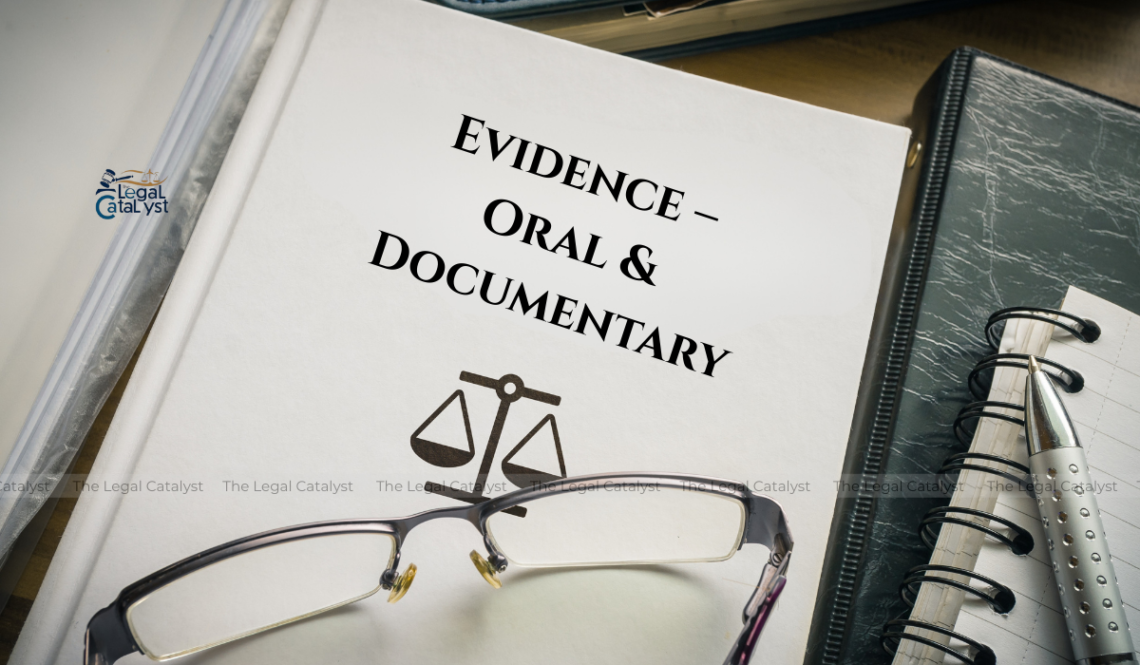
Under the law of evidence, proof happens in only two legally recognised ways: through oral evidence and documentary evidence. Everything else—circumstantial narratives, arguments, suspicions—must ultimately flow into one of these two forms to be legally usable.
If you don’t understand this division, you don’t understand how courts decide facts.
The framework is laid down in the Indian Evidence Act, 1872, particularly Sections 3, 59–65.
Oral Evidence
Meaning
Oral evidence refers to statements made by witnesses before the court relating to facts under inquiry.
In simple terms:
What a witness says in court, on oath, is oral evidence.
Oral evidence is based on human perception—what a person saw, heard, felt, or experienced.
Rule of Directness
The most important rule governing oral evidence is this:
Oral evidence must be direct.
This means:
- If the fact is something seen → the witness must have seen it
- If the fact is something heard → the witness must have heard it
- If the fact is perceived by any sense → the witness must have perceived it
Hearsay is generally excluded because it cannot be tested through cross-examination.
No shortcut. No second-hand stories.
Also Read- Order vs Decree
Value of Oral Evidence
Oral evidence:
- Is flexible and immediate
- Depends heavily on credibility
- Is tested through cross-examination
Courts look at:
- Consistency
- Demeanour
- Probability
- Corroboration
A single truthful witness can be sufficient.
Multiple unreliable witnesses are useless.
Limitations of Oral Evidence
Oral evidence is vulnerable to:
- Memory lapses
- Bias
- Coaching
- Fear or influence
That is why courts are cautious and often look for support from documentary or circumstantial evidence.
Documentary Evidence
Meaning
Documentary evidence consists of documents produced before the court for inspection.
A document is anything that records information in a permanent or semi-permanent form—written, printed, electronic, or recorded.
Documents speak silently, but powerfully.
Types of Documentary Evidence
Documentary evidence is classified into primary and secondary evidence.
Primary Evidence
Primary evidence means the original document itself produced before the court.
The law prefers primary evidence because it carries the highest reliability.
If the original document exists and can be produced, nothing else is acceptable.
Secondary Evidence
Secondary evidence includes:
- Certified copies
- Photocopies
- Counterparts
- Oral accounts of document contents (in limited cases)
Secondary evidence is allowed only when the original cannot be produced, and the reason for non-production is legally justified.
Courts do not allow secondary evidence casually. The foundation must be laid first.
Rule: Best Evidence
Documentary evidence operates on the best evidence rule:
Produce the best available form of the document.
Inferior substitutes are not entertained without explanation.
This rule prevents manipulation and fabrication.
Oral vs Documentary Evidence – Conflict Rule
When oral evidence contradicts documentary evidence, courts generally prefer documentary evidence.
Why?
Because documents are created closer to the transaction and are less prone to later distortion.
However, documents are not infallible. If a document is suspicious, fabricated, or incomplete, oral evidence may prevail.
Substance beats form—but credibility decides.
Also Read- Reference, Review & Revision
Oral Evidence Cannot Replace Documents
Where the law requires a transaction to be in writing, oral evidence cannot be used to contradict, vary, or substitute the document.
This prevents parties from rewriting contracts and legal obligations through testimony.
Electronic Records as Documentary Evidence
Electronic records are treated as documentary evidence, but governed by special rules for admissibility.
Without statutory compliance, electronic data is legally worthless, no matter how real it looks.
Digital proof is not casual proof.
Why This Distinction Matters
Because:
- Different admissibility rules apply
- Different standards of reliability apply
- Different burdens arise
Many cases collapse not because facts are false, but because evidence is presented in the wrong form.
Common Mistakes
- Treating hearsay as oral evidence
- Producing photocopies without foundation
- Ignoring the best evidence rule
- Mixing arguments with evidence
- Assuming relevance equals admissibility
Courts reject evidence, not stories.
Also Read- Preliminary Decree vs Final Decree
Oral evidence speaks through people.
Documentary evidence speaks through records.
One tests memory and credibility.
The other tests authenticity and integrity.
Courts do not choose between them blindly. They weigh them together, cautiously and logically.
Connect with us on Instagram – X – LinkedIn for daily updates, quizzes, and other materials