
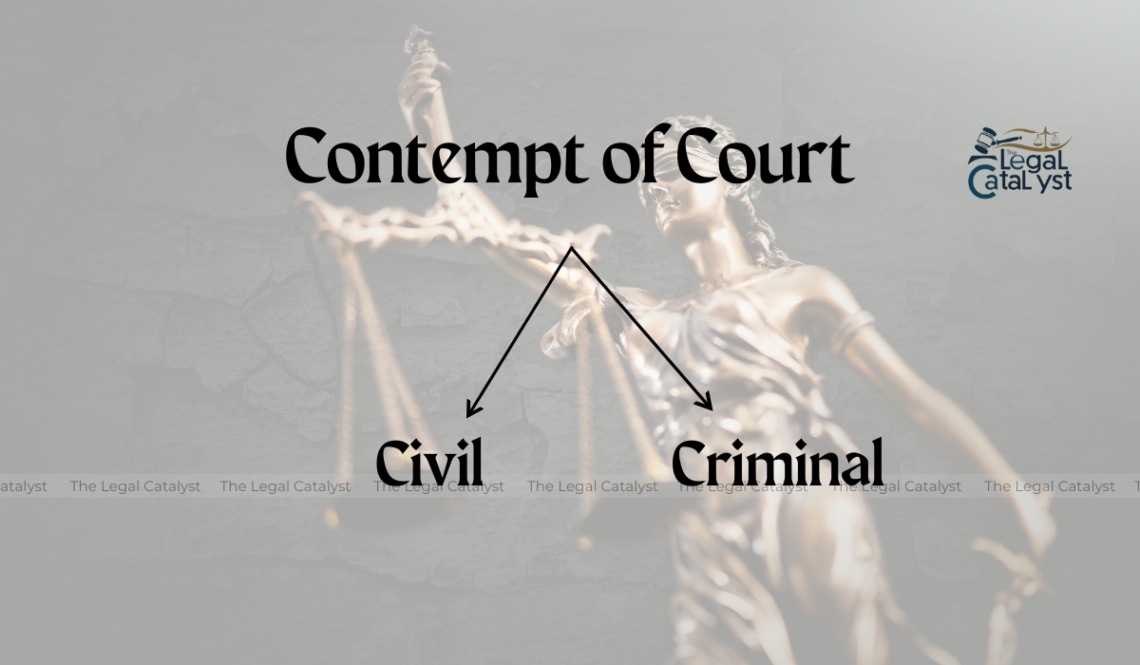
Indian law recognises two distinct forms of contempt: civil contempt and criminal contempt. Though often confused, their nature, purpose, and consequences are fundamentally different.
The power to punish for contempt is an essential judicial function. Courts do not exercise this power to protect individual judges, but to safeguard the administration of justice and maintain public confidence in the judicial system.
Meaning of Contempt of Court
Contempt of court refers to conduct that:
- Disobeys or disrespects judicial authority, or
- Interferes with the due course of justice, or
- Undermines public confidence in courts
The law on contempt is primarily governed by the Contempt of Courts Act, 1971, and supplemented by constitutional powers of the Supreme Court and High Courts.
Civil Contempt
Civil contempt relates to wilful disobedience of court orders.
Definition
Civil contempt means:
- Wilful disobedience of any judgment, decree, direction, order, or writ of a court, or
- Wilful breach of an undertaking given to a court
The emphasis is on non-compliance, not disrespect.
Also Read- Difference Between BNS, BNSS and CPC
Nature of Civil Contempt
Civil contempt is:
- Remedial in nature
- Intended to enforce compliance with court orders
- Concerned with private rights rather than public justice
The objective is not punishment for its own sake, but to ensure that judicial orders are obeyed.
If compliance is achieved, courts may take a lenient view.
Essential Ingredients of Civil Contempt
For civil contempt to be established:
- A lawful court order must exist
- The contemnor must have knowledge of the order
- Disobedience must be wilful and deliberate
Mere inability or accidental non-compliance does not amount to civil contempt.
Criminal Contempt
Criminal contempt concerns acts that undermine the authority of the judiciary or obstruct justice.
Definition
Criminal contempt includes:
- Scandalising or lowering the authority of a court
- Prejudicing or interfering with judicial proceedings
- Obstructing the administration of justice in any other manner
This form of contempt affects not just an individual case, but the institution of justice itself.
Nature of Criminal Contempt
Criminal contempt is:
- Punitive in nature
- Concerned with public interest
- Designed to protect judicial credibility
Unlike civil contempt, compliance or apology does not automatically erase liability, though it may mitigate punishment.
Acts Amounting to Criminal Contempt
Examples include:
- Publishing material that prejudices a pending trial
- Making reckless allegations against judges
- Disrupting court proceedings
- Attempts to influence judges or witnesses
Fair criticism of judicial decisions, however, does not amount to criminal contempt if made in good faith.
Also Read- Appeal, Revision and Review
Key Differences Between Civil and Criminal Contempt
Civil contempt involves wilful disobedience of court orders and focuses on enforcement of compliance. Criminal contempt involves acts that interfere with or undermine the administration of justice and focuses on punishment.
Civil contempt is remedial.
Criminal contempt is punitive.
Civil contempt protects private rights.
Criminal contempt protects public confidence in courts.
Punishment for Contempt
Punishment for both civil and criminal contempt may include:
- Simple imprisonment up to six months
- Fine
- Or both
Courts may discharge the contemnor if an apology is bona fide and made in good faith.
However, an apology cannot be used as a shield for deliberate or repeated contempt.
Constitutional Position
The Supreme Court and High Courts are courts of record and possess inherent power to punish for contempt under the Constitution. This power exists independently of statutory law and cannot be taken away by legislation.
Common Misconceptions
Criticism of judgments is not contempt if done responsibly.
Contempt jurisdiction is not meant to silence dissent.
Disobedience must be wilful to constitute civil contempt.
Treating contempt as a personal ego issue of judges is legally incorrect.
Civil and criminal contempt serve distinct but complementary purposes. Civil contempt ensures obedience to judicial orders, while criminal contempt preserves the authority and integrity of the justice system.
Both are exceptional powers, to be exercised with restraint, but their existence is indispensable for the rule of law.
Understanding this distinction is essential for litigators, journalists, law students, and anyone engaging with the judicial process.
Connect with us on Instagram – X – LinkedIn for daily updates, quizzes, and other materials.