
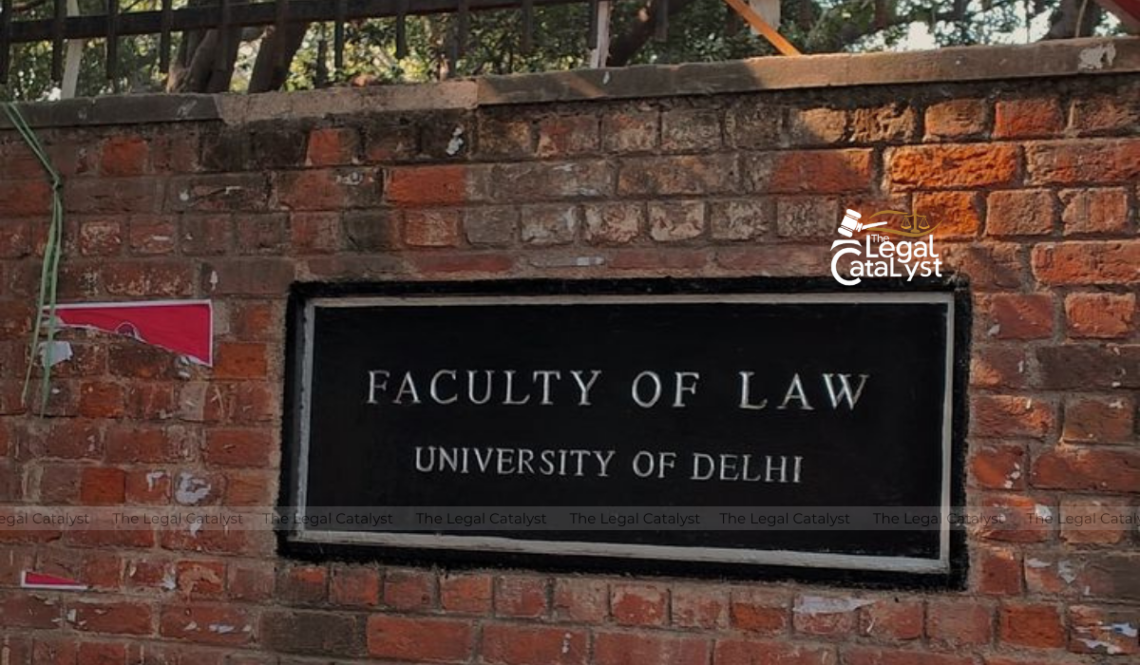
- Introduction and Institutional Identity
- Foundational Objective and Institutional Evolution
- Location-Based Academic and Career Exposure
- Courses Offered and Entry Pathways
- Academic Structure and Teaching Reality
- Academic Rigor and Evaluation Standards
- Fee Structure and True Cost of Education
- Internship Ecosystem and Practical Exposure
- Moot Court, Research, and Co-Curricular Opportunities
- Placements and Career Outcomes
- Alumni Network and Long-Term Value
- Campus Culture and Student Experience
- Administration and Institutional Governance
- Multi-Campus or Branch Structure
- Suitability Analysis
- Who Should Avoid This University
- Comparative Positioning
- Final Verdict
Introduction and Institutional Identity
The Faculty of Law, University of Delhi (DU), is one of India’s oldest and most recognisable public law institutions. Established in 1924 as part of the University of Delhi, it operates as a constituent faculty of a central university rather than an autonomous law school. It is located in North Campus, Delhi, and is regulated by the Bar Council of India and the University Grants Commission.
The Faculty of Law is a Non-NLU law institution. It does not follow the residential, fully integrated, centrally managed model associated with National Law Universities. Instead, it operates as a large, publicly funded academic faculty catering to a high volume of students across multiple programmes. Any evaluation must therefore factor in scale, public university constraints, and the absence of the NLU-style ecosystem.
Foundational Objective and Institutional Evolution
The Faculty of Law was established during the colonial period with the objective of providing formal legal education to support the judiciary, civil services, and legal profession in British India. Its early focus was on doctrinal legal education aimed at producing courtroom-ready lawyers and public servants.
Over time, the institution expanded its intake and programmes to meet rising demand for legal education in independent India. Unlike NLUs, which were designed as reformist institutions emphasising small batches, continuous assessment, and residential learning, the Faculty of Law evolved as a mass-access public institution. The introduction of the five-year integrated LL.B. programme in the last decade marked a partial shift toward contemporary legal education models, but the core structure remains examination-driven and lecture-centric.
Explore- National Law University Tripura (NLUT), Agartala
Location-Based Academic and Career Exposure
Delhi is one of the strongest legal ecosystems in the country. The Faculty of Law benefits directly from this location.
Advantages
Proximity to the Supreme Court of India, Delhi High Court, district courts, tribunals, and national commissions provides unmatched litigation exposure. Central government ministries, regulatory bodies, policy think tanks, and law firms are concentrated in the city. Internships during semesters are realistically possible due to geographic access.
Limitations
Exposure is not institutionally structured. Students must self-navigate opportunities. There is no compulsory clinical integration tying court exposure to academic credit. Competition for internships in Delhi is intense, and average students without initiative or networks often fail to capitalise on the location advantage.
Courses Offered and Entry Pathways
| Programme | Duration | Entry Pathway |
|---|---|---|
| B.A. LL.B. (Hons.) | 5 years | CLAT-UG (Law) |
| LL.B. | 3 years | CUET-PG (Law) |
| LL.M. | 2 years | CUET-PG |
| Ph.D. (Law) | Variable | University-level admission process |
Admissions are centralised through CUET, reducing discretion and opacity. However, high cut-offs mean the student body is academically heterogeneous once enrolled.
Academic Structure and Teaching Reality
Teaching is predominantly lecture-based. Class sizes are large, particularly in the three-year LL.B. programme, often exceeding 100 students per section. Faculty composition includes senior professors with strong doctrinal grounding, mid-career academics, and ad-hoc lecturers.
Classroom seriousness varies widely. While some professors maintain high academic standards, attendance enforcement and participation expectations are inconsistent. Students relying solely on classroom teaching without self-study generally struggle to develop applied legal skills.
Academic Rigor and Evaluation Standards
Attendance requirements exist formally but enforcement varies by course and faculty member. Internal assessments typically include presentations, mid-semester tests, and assignments, but grading standards are uneven.
End-semester examinations remain the primary determinant of performance. The grading culture is conservative, with limited grade inflation. High distinctions are rare, and average scores cluster in the mid-range. This benefits disciplined students but disadvantages those expecting continuous feedback and mentoring.
Fee Structure and True Cost of Education
| Cost Component | Approximate Amount (INR) |
|---|---|
| Annual Tuition Fees | 5,000–15,000 |
| Hostel and Living (Annual) | 1,20,000–2,00,000 |
| Estimated Total Course Cost (5 years) | 6–9 lakhs |
| Estimated Total Course Cost (3 years) | 3.5–5 lakhs |
The Faculty of Law is among the most affordable quality legal education options in India. However, low fees correlate with limited institutional services, infrastructure constraints, and minimal administrative support.
Internship Ecosystem and Practical Exposure
Internships are entirely student-driven. Delhi courts, chambers, firms, NGOs, and government offices offer abundant opportunities, but there is no structured placement or internship cell assigning roles.
Vacation internships are common, but semester internships depend on time management and faculty flexibility. Litigation exposure is strong for motivated students, while corporate exposure requires proactive outreach.
Explore- Maharashtra National Law University (MNLU), Chhatrapati Sambhajinagar
Moot Court, Research, and Co-Curricular Opportunities
Mooting culture exists but is not institutionally dominant. Participation depends on student societies rather than faculty-driven programmes. Research centres function primarily for postgraduate and doctoral work, with limited undergraduate integration.
Law journals and publication opportunities exist but lack consistent mentoring. Students aiming for academic careers must self-develop research discipline.
Placements and Career Outcomes
There is no centralised placement system comparable to NLUs. Recruitments are informal and largely dependent on individual effort. A small number of students secure law firm roles, policy positions, or research fellowships, but these outcomes are not representative.
The majority of graduates pursue litigation, judicial services preparation, further studies, or non-legal careers. Average outcomes reflect the student’s initiative rather than institutional branding.
Alumni Network and Long-Term Value
The alumni base is extensive due to decades of operation. Graduates occupy positions across litigation, judiciary, academia, bureaucracy, and politics. However, alumni engagement is decentralised and informal. Networking benefits accrue slowly and unevenly.
Campus Culture and Student Experience
The environment is competitive but fragmented. Peer quality varies significantly. Discipline is moderate, with limited monitoring outside classrooms. Student societies fill institutional gaps but lack funding consistency.
Support systems for mental health, career guidance, and academic counselling are minimal compared to private or autonomous institutions.
Administration and Institutional Governance
Administrative processes are slow and bureaucratic. Communication gaps are common. Policy changes, examination schedules, and grievance redressal often lack transparency. These issues disproportionately affect students unfamiliar with public university systems.
Multi-Campus or Branch Structure
The Faculty of Law operates from a single primary campus in North Delhi. There are no branch campuses offering law programmes. Academic standards, faculty, and administration are uniform across programmes, subject to batch size differences.
Suitability Analysis
Best suited for students who are self-motivated, cost-sensitive, interested in litigation or public service, and capable of navigating unstructured systems independently. Students with strong academic discipline and initiative benefit most.
Who Should Avoid This University
Students seeking guaranteed placements, intensive faculty mentoring, residential campus life, or tightly structured academic environments are likely to be dissatisfied. Those uncomfortable with large class sizes and administrative delays may struggle.
Explore- National Law School of India University (NLSIU), Bengaluru
Comparative Positioning
Compared to Government Law College Mumbai, the Faculty of Law offers stronger Delhi-based exposure but weaker institutional placements. Compared to ILS Law College Pune, it is more affordable but less academically structured. It does not match top NLUs in infrastructure, mentoring, or placements but competes strongly on cost and litigation access.
Final Verdict
The Faculty of Law, University of Delhi, is not a premium, hand-holding institution. It is a high-potential, low-cost platform in a powerful legal ecosystem. For disciplined students willing to build their own careers, it offers substantial long-term value. For students expecting institutional guarantees, it is likely to disappoint. The worth of this university depends less on its name and more on the student’s capacity to extract value from it.
Connect with us on Instagram – X – LinkedIn for daily updates, quizzes, and other materials