- Introduction and Institutional Identity
- Foundational Objective and Institutional Intent
- Location-Based Academic and Career Exposure
- Academic Structure and Teaching Methodology
- Academic Rigor and Evaluation Standards
- Fee Structure and Real Cost of Legal Education
- Internship Ecosystem and Practical Exposure
- Moot Court, Research, and Co-Curricular Culture
- Placements and Career Outcomes
- Alumni Network and Long-Term Value
- Campus Culture, Competition, and Student Well-Being
- Administration and Institutional Governance
- Suitability Analysis
- Who Should Avoid This Law School
- Comparative Positioning
- Final Verdict
- Overall Institutional Standing
- Core Strengths
- Structural Weaknesses
- Return on Investment (ROI) Assessment
- Consistency of Outcomes
- Final Legal Catalyst Take
Introduction and Institutional Identity
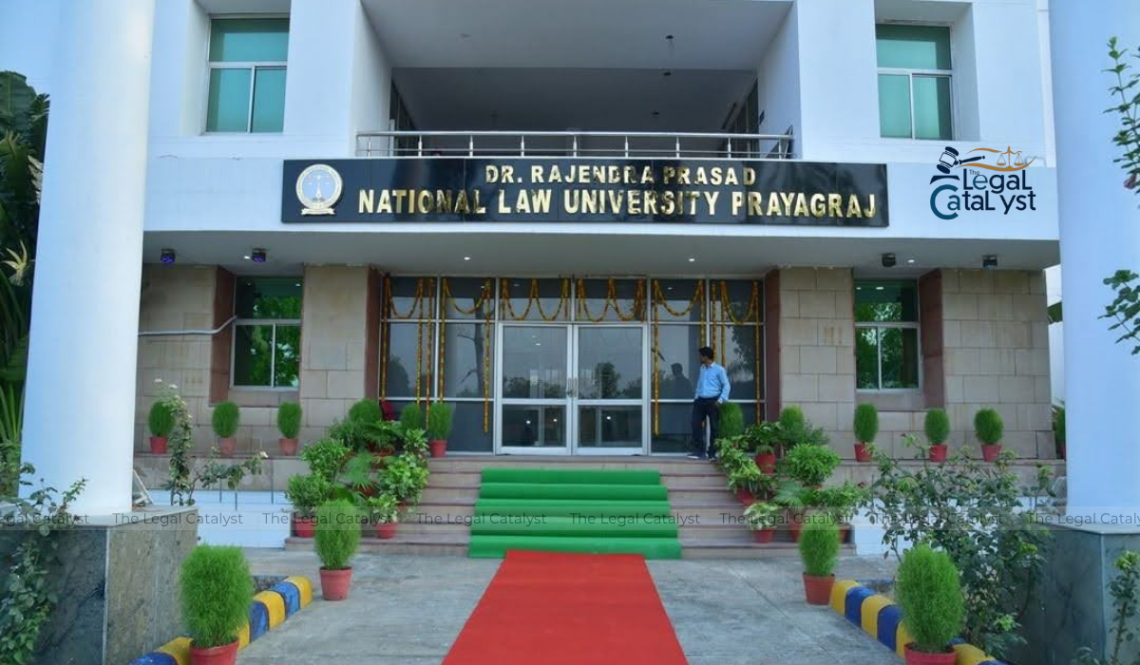
Dr. Rajendra Prasad National Law University (RPNLU) was established in 2020 by an Act of the Uttar Pradesh State Legislature. It is a public law university, located in Prayagraj, Uttar Pradesh, and functions as an autonomous institution within the national law university framework. The university is recognized by the University Grants Commission (UGC) and approved by the Bar Council of India (BCI). Its official website is www.rpnlup.ac.in.
RPNLU currently offers the five-year B.A., LL.B. (Hons.) programme and is in the process of stabilising its postgraduate and research offerings. It is one of the newest NLUs in India and remains in an early stage of institutional development.
Foundational Objective and Institutional Intent
RPNLU was created to expand access to national-level legal education in eastern Uttar Pradesh and to leverage Prayagraj’s historical association with courts, constitutional litigation, and legal scholarship. The founding intent combined regional inclusion with an implied aspiration to reconnect Prayagraj to its legacy as a litigation and judicial hub.
In practice, the institution has prioritised basic operational establishment over strategic academic or professional leadership. While the objective of access has been met, the translation of Prayagraj’s historical legal significance into contemporary institutional advantage remains largely unrealised. Alignment with intent exists in geography, not yet in outcomes.
Location-Based Academic and Career Exposure
Prayagraj hosts the Allahabad High Court, one of the most significant High Courts in India, along with a dense ecosystem of senior advocates, chambers, and constitutional litigation. This is a genuine structural advantage for students inclined toward litigation and judicial services.
However, beyond court-centric exposure, the city offers limited diversity of legal opportunity. There is no corporate legal market, minimal arbitration or policy infrastructure, and negligible presence of national law firms. Semester-time internships are feasible primarily within litigation and government offices. Students targeting corporate law, policy, or national-level roles must rely on vacation internships in Delhi, Mumbai, or Bengaluru. The location is a strength for litigation-focused goals but a constraint for broader career paths.
Also Explore- National Law University Tripura (NLUT), Agartala
Academic Structure and Teaching Methodology
The B.A., LL.B. (Hons.) curriculum follows the standard NLU model, integrating humanities subjects in the early years with core substantive and procedural law courses in later semesters.
Teaching methodology is largely lecture-based, reflecting early-stage capacity constraints. Clinical education, skills training, and experiential learning are limited. Faculty composition is thin and evolving, with a mix of early-career academics and contractual appointments. Faculty continuity and depth remain concerns. Academic seriousness is expected, but structured mentoring, research integration, and pedagogical innovation are limited.
Academic Rigor and Evaluation Standards
Attendance requirements are prescribed and enforced in a formal sense. Evaluation methods include internal assessments, mid-semester examinations, end-term examinations, and written assignments.
Academic rigor is low to moderate. Grading standards are lenient, competition is limited, and academic differentiation is weak. This reduces stress but also lowers academic discipline and preparedness for competitive environments. Feedback systems and academic advising are underdeveloped.
Fee Structure and Real Cost of Legal Education
Official tuition fees are approximately ₹2.0–2.2 lakh per year. Hostel and mess charges add around ₹70,000–90,000 annually. Living expenses in Prayagraj are relatively low, with personal and incidental costs typically ranging between ₹50,000–70,000 per year.
The total estimated cost of completing the five-year programme is approximately ₹15–18 lakh, placing RPNLU among the more affordable NLUs. Affordability is a relative strength, but cost must be weighed against opportunity cost and outcome predictability.
Internship Ecosystem and Practical Exposure
Semester-time internships are largely confined to High Court litigation, district courts, and government offices. This suits students focused on litigation but offers little variety.
Meaningful exposure beyond litigation is secured during vacations and is entirely student-driven. Alumni support is minimal due to the institution’s recent establishment. There is no institutional pipeline ensuring baseline-quality internships. Practical exposure for the average student is uneven and dependent on personal initiative and networks.
Moot Court, Research, and Co-Curricular Culture
Co-curricular culture at RPNLU is nascent. Moot court and ADR activities exist but lack scale, consistency, and institutional memory. Participation in national-level competitions is limited.
Research centres and journals are at an early stage. Research output is minimal, and faculty-led mentorship for publication is sporadic. At present, co-curricular activities do not significantly offset academic or professional limitations.
Placements and Career Outcomes
Placement outcomes at RPNLU are largely indeterminate due to the absence of mature graduating batches and consistent placement reporting. There is no established placement mechanism comparable to older NLUs.
Based on structural indicators and early outcomes, realistic career paths for the majority of students include litigation, judicial services preparation, local practice, compliance roles, or non-legal careers. National law firm placements should not be assumed. Verified, granular placement data is not consistently available, limiting transparency.
Alumni Network and Long-Term Value
RPNLU’s alumni network is very young and undeveloped. Alumni presence is limited to early-stage litigation, government roles, and preparatory career paths.
Alumni engagement with current students is minimal. Long-term brand value is uncertain and will depend on institutional stability and outcome consistency over the next decade. At present, alumni leverage is negligible.
Campus Culture, Competition, and Student Well-Being
Campus culture is low-pressure and inward-focused. Peer competition is limited, and ambition levels vary widely. While this creates a manageable environment, it also risks complacency among average students.
Mental health and counselling infrastructure is minimal. Institutional career guidance systems are underdeveloped. Students are largely expected to self-manage academic and professional uncertainty.
Also Explore- Himachal Pradesh National Law University (HPNLU), Shimla
Administration and Institutional Governance
Administrative functioning is nascent and bureaucratic. As a new institution, RPNLU faces predictable issues related to staffing, policy clarity, and procedural consistency.
Decision-making is slow, communication is uneven, and governance structures are still stabilising. Administrative focus remains on operational continuity rather than strategic academic or professional development.
Suitability Analysis
RPNLU is best suited for students seeking a low-cost NLU education with a clear inclination toward litigation, constitutional law, or judicial services preparation, particularly within Uttar Pradesh.
Who Should Avoid This Law School
Students seeking national corporate placements, research-intensive education, strong academic mentorship, or predictable professional outcomes should avoid RPNLU. Those relying on institutional systems rather than self-driven effort are likely to struggle.
Comparative Positioning
Compared to Dr. Ram Manohar Lohiya National Law University, RPNLU is cheaper but significantly weaker in institutional maturity and placements. In comparison with National University of Study and Research in Law, RPNLU offers stronger litigation exposure due to High Court access but remains similarly weak in alumni leverage and national outcomes.
Final Verdict
RPNLU Prayagraj is a litigation-oriented but institutionally immature law university. It provides affordable access to legal education and proximity to a major High Court but does not yet justify five years of investment for students seeking broad or nationally competitive careers. For disciplined, litigation-focused students with realistic expectations, it may serve as a functional base. For others, the opportunity cost is significant.
Also Explore- Gujarat National Law University (GNLU), Silvassa Campus
The Legal Catalyst Review
Overall Institutional Standing
RPNLU occupies a lower-tier position within India’s national law university ecosystem, with relevance driven more by location than institutional performance.
Core Strengths
Access to a major High Court, relatively low cost of education, and inclusion within the NLU framework provide limited but tangible value.
Structural Weaknesses
Institutional infancy, weak placement systems, minimal research culture, negligible alumni leverage, and limited faculty depth significantly constrain average student outcomes.
Return on Investment (ROI) Assessment
ROI is low to uncertain. Financial costs are controlled, but professional outcomes for the median student rarely justify the five-year investment without exceptional self-driven effort.
Consistency of Outcomes
Outcomes are overwhelmingly student-dependent. Institutional systems currently add little predictive value.
Final Legal Catalyst Take
RPNLU delivers access anchored in litigation geography, not institutional strength. It does not provide predictable value and requires sustained, self-directed effort to convert location advantage into meaningful outcomes.
Connect with us on Instagram – X – LinkedIn for daily updates, quizzes, and other materials