- Introduction and Institutional Identity
- Foundational Objective and Institutional Intent
- Location-Based Academic and Career Exposure
- Academic Structure and Teaching Methodology
- Academic Rigor and Evaluation Standards
- Fee Structure and Real Cost of Legal Education
- Internship Ecosystem and Practical Exposure
- Moot Court, Research, and Co-Curricular Culture
- Placements and Career Outcomes
- Alumni Network and Long-Term Value
- Campus Culture, Competition, and Student Well-Being
- Administration and Institutional Governance
- Suitability Analysis
- Who Should Avoid This Law School
- Comparative Positioning
- Final Verdict
- Overall Institutional Standing
- Core Strengths
- Structural Weaknesses
- Return on Investment (ROI) Assessment
- Consistency of Outcomes
- Final Legal Catalyst Take
Introduction and Institutional Identity
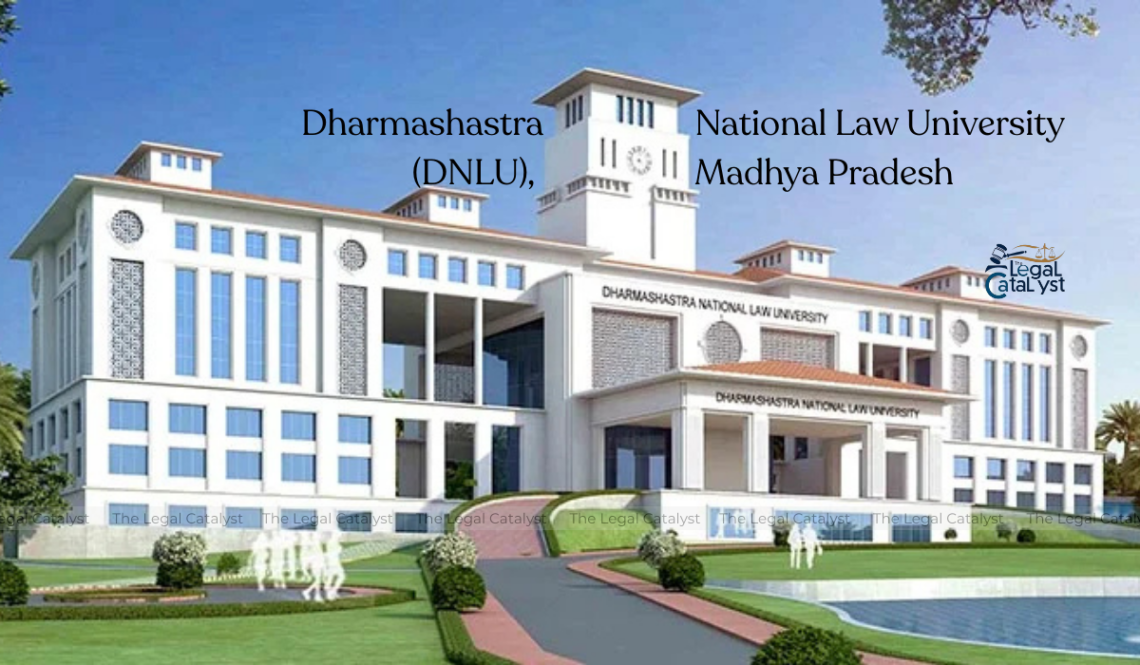
Dharmashastra National Law University (DNLU) was established in 2018 by an Act of the Madhya Pradesh State Legislature. It is a public law university, located in Jabalpur, Madhya Pradesh, and operates as an autonomous institution. The university is recognized by the University Grants Commission (UGC) and approved by the Bar Council of India (BCI). Its official website is www.mpdnlu.ac.in.
DNLU offers a five-year B.A., LL.B. (Hons.), a one-year LL.M., and doctoral programmes. It is among the newest entrants in the national law university system and remains in an early stage of institutional development.
Foundational Objective and Institutional Intent
DNLU was created to extend national-level legal education to central India and to build a talent pipeline for litigation, judiciary, and public service within Madhya Pradesh. The founding intent was primarily regional access and judicial orientation, not national academic leadership or corporate dominance.
In practice, the institution aligns closely with this modest objective. DNLU’s focus has been on basic infrastructure, compliance, and incremental academic functioning. There is little evidence of a clearly articulated long-term vision aimed at competing with established NLUs. Alignment exists, but ambition is limited, and execution reflects a survival-first approach rather than institutional leadership.
Location-Based Academic and Career Exposure
Jabalpur offers limited but specific legal exposure. It houses the principal bench of the Madhya Pradesh High Court, which provides access to constitutional litigation, criminal practice, and civil advocacy. This is a tangible advantage for students inclined toward litigation or judicial services.
However, Jabalpur lacks a corporate legal ecosystem, arbitration centres, policy institutions, or national law firm presence. Semester-time internships beyond court-based work are scarce. Students aiming for corporate law, policy roles, or national litigation must depend almost entirely on vacation internships in Delhi, Mumbai, Indore, or Bhopal. Geographic isolation limits opportunity density for the average student.
Also Read- Tamil Nadu National Law University (TNNLU), Tiruchirappalli
Academic Structure and Teaching Methodology
The B.A., LL.B. (Hons.) programme follows the standard NLU curriculum, combining humanities subjects in early semesters with core law subjects in later years. Teaching methodology is predominantly lecture-based, with limited emphasis on experiential learning, clinics, or skills training.
Faculty composition is unstable and thin. The university has struggled with faculty recruitment and retention. Dependence on visiting faculty and short-term appointments affects academic continuity. Teaching quality varies widely, and course depth is inconsistent. Academic seriousness is expected but not structurally supported through mentoring or research-led instruction.
Academic Rigor and Evaluation Standards
Attendance requirements are prescribed and generally enforced. Evaluation systems include mid-term examinations, end-semester examinations, internal assessments, and written assignments.
Academic rigor is low to moderate. Grading standards are lenient, competitive academic pressure is minimal, and academic differentiation is weak. While this creates a low-stress environment, it undermines intellectual discipline and incentives for sustained academic effort. Structured feedback and academic advising remain underdeveloped.
Fee Structure and Real Cost of Legal Education
Official tuition fees are approximately ₹2.2–2.4 lakh per year. Hostel and mess charges add around ₹80,000–1 lakh annually. Living expenses in Jabalpur are relatively low, with personal and incidental costs typically ranging between ₹50,000–70,000 per year.
The total estimated cost of completing the five-year programme is approximately ₹17–20 lakh, placing DNLU in the lower-to-mid cost bracket among NLUs. While affordability is a relative strength, cost advantage alone does not compensate for weak institutional outcomes.
Internship Ecosystem and Practical Exposure
Semester-time internships are largely confined to local litigation chambers, courts, and government offices. High-quality or nationally relevant internships are almost entirely secured during vacations and are fully student-driven.
Alumni support is minimal due to the institution’s recent establishment. A small number of highly proactive students manage to secure meaningful internships. The majority graduate with fragmented or low-impact exposure. There is no institutional framework ensuring baseline professional readiness.
Moot Court, Research, and Co-Curricular Culture
DNLU has basic moot court and ADR structures, but co-curricular culture is nascent and inconsistent. Participation in national moots and competitions is limited and sporadic.
Research centres and journals exist primarily on paper. Research output is minimal, and faculty-led research mentorship is rare. Publication opportunities exist in form but not in substance. Co-curricular success depends almost entirely on individual student initiative.
Placements and Career Outcomes
Placement outcomes at DNLU are weak and largely informal. Recruitment by national law firms or prominent organisations is extremely rare.
Most graduates pursue litigation, judicial services preparation, local practice, compliance roles, or non-legal careers. Publicly verifiable and granular placement data is not consistently available, but available indicators suggest minimal institutional placement leverage. Career trajectories are overwhelmingly determined by individual effort rather than institutional systems.
Also Read- National Law University Odisha (NLUO), Cuttack
Alumni Network and Long-Term Value
DNLU’s alumni network is very young and regionally concentrated. Alumni are primarily engaged in Madhya Pradesh–based litigation, state services, and small practices.
Alumni engagement with current students is limited and informal. The alumni base does not yet provide meaningful leverage for internships, mentorship, or placements. Long-term brand value remains weak outside the state.
Campus Culture, Competition, and Student Well-Being
Campus culture is low-pressure and inward-looking. Peer competition is limited, and professional ambition varies widely. This creates a relatively calm environment but also encourages complacency among average students.
Mental health and counselling infrastructure is minimal. Institutional support systems for academic or career uncertainty are weak. Students are largely expected to navigate challenges independently.
Administration and Institutional Governance
Administrative functioning is bureaucratic and slow. Communication gaps, procedural rigidity, and inconsistent policy implementation are common concerns. Leadership continuity has been inconsistent, affecting institutional momentum.
While governance structures exist formally, execution lacks efficiency and transparency. Administrative inertia remains a significant constraint on academic consolidation and professional integration.
Suitability Analysis
DNLU is best suited for students seeking a lower-cost NLU education with an interest in litigation, judicial services preparation, or regional legal practice, and who are prepared to rely primarily on self-driven effort for career development.
Who Should Avoid This Law School
Students seeking national corporate placements, strong academic mentorship, research-driven education, or predictable professional outcomes should avoid DNLU. Those expecting institutional branding to compensate for average effort are likely to be disappointed.
Comparative Positioning
Compared to Hidayatullah National Law University, DNLU is cheaper but significantly weaker in alumni leverage and institutional maturity. In comparison with Maharashtra National Law University Nagpur, DNLU offers similar litigation exposure but lags further behind in academic consolidation and placements.
Final Verdict
DNLU Jabalpur is a low-leverage, early-stage law university. It provides access to legal education at a manageable cost but does not reliably convert five years of study into strong professional outcomes for the average student. It may work for disciplined, region-focused students with realistic expectations. For those seeking national mobility or institutional advantage, the opportunity cost is substantial.
Also Read- Himachal Pradesh National Law University (HPNLU), Shimla
The Legal Catalyst Review
Overall Institutional Standing
DNLU occupies a lower-tier position within India’s national law university ecosystem. Its influence and outcomes remain largely regional.
Core Strengths
Relatively low cost, access to a High Court litigation environment, and basic campus infrastructure provide limited foundational value.
Structural Weaknesses
Faculty instability, weak placement mechanisms, negligible research culture, minimal alumni leverage, and administrative inertia significantly constrain average student outcomes.
Return on Investment (ROI) Assessment
ROI is low. While financial costs are controlled, career outcomes for the median student rarely justify the five-year investment without exceptional individual effort.
Consistency of Outcomes
Success at DNLU is almost entirely student-dependent. Institutional systems contribute little beyond degree certification.
Final Legal Catalyst Take
DNLU delivers access without acceleration. It functions as a regional holding institution rather than a growth platform. It does not deliver predictable value and demands exceptional self-driven effort to overcome structural and institutional limitations.
Connect with us on Instagram – X – LinkedIn for daily updates, quizzes, and other materials