- Introduction and Institutional Identity
- Foundational Objective and Institutional Intent
- Location-Based Academic and Career Exposure
- Academic Structure and Teaching Methodology
- Academic Rigor and Evaluation Standards
- Fee Structure and Real Cost of Legal Education
- Internship Ecosystem and Practical Exposure
- Moot Court, Research, and Co-Curricular Culture
- Placements and Career Outcomes
- Alumni Network and Long-Term Value
- Campus Culture, Competition, and Student Well-Being
- Administration and Institutional Governance
- Suitability Analysis
- Who Should Avoid This Law School
- Comparative Positioning
- Final Verdict
- Overall Institutional Standing
- Core Strengths
- Structural Weaknesses
- Return on Investment (ROI) Assessment
- Consistency of Outcomes
- Final Legal Catalyst Take
Introduction and Institutional Identity
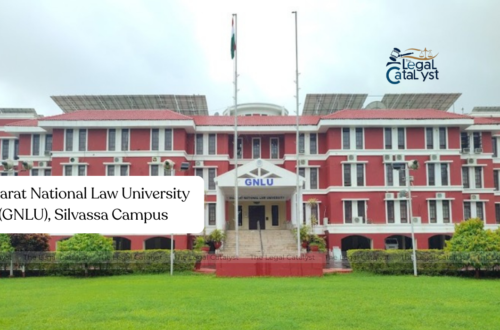
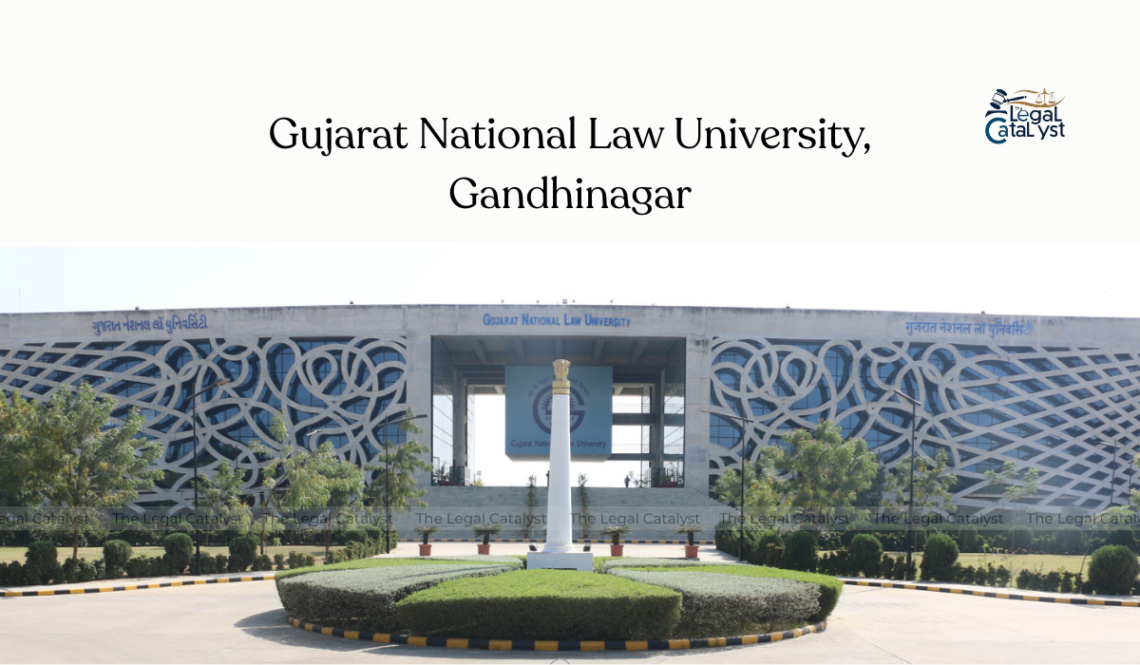
Gujarat National Law University (GNLU) was established in 2003 by an Act of the Gujarat State Legislature. It is a public law university located in Gandhinagar, Gujarat, operating as an autonomous institution. The university is recognized by the University Grants Commission (UGC) and approved by the Bar Council of India (BCI). Its official website is www.gnlu.ac.in.
GNLU offers a five-year integrated B.A., LL.B. (Hons.), a B.Com., LL.B. (Hons.), postgraduate law programmes, doctoral degrees, and a range of diploma and executive education courses. It belongs to the early second generation of National Law Universities and has pursued visible institutional expansion over the last decade.
Foundational Objective and Institutional Intent
GNLU was created to strengthen legal education in western India and to align legal training with commercial, regulatory, and governance needs of a rapidly industrialising region. Unlike institutions founded with strong public law or academic orientations, GNLU’s founding vision emphasised institution-building, infrastructure development, and professional relevance.
In its current functioning, the university largely aligns with this intent. GNLU has focused on expanding programmes, research centres, and international linkages. However, this expansion-driven approach has sometimes prioritised scale and visibility over academic depth and pedagogical consistency. The institution has ambition and administrative drive, but its core educational outcomes remain uneven across the student body.
Location-Based Academic and Career Exposure
Gandhinagar offers moderate advantages. Proximity to Ahmedabad provides access to High Court litigation, arbitration practices, regulatory bodies, and a growing corporate ecosystem. Gujarat’s strong industrial base creates opportunities in compliance, in-house legal roles, and regulatory advisory work.
At the same time, Gandhinagar itself is administratively oriented rather than commercially dense. Semester-time internships are possible but limited in variety and scale compared to Delhi, Mumbai, or Bengaluru. Students seeking national-level corporate or policy exposure must rely heavily on vacation internships outside the state. The location is an advantage for region-focused careers, not a substitute for metropolitan legal ecosystems.
Also Read- National Law University, Jodhpur (NLUJ)
Academic Structure and Teaching Methodology
GNLU’s undergraduate programmes follow a structured interdisciplinary curriculum. Teaching methods include lectures, seminars, projects, simulations, and assessments. The university has invested in specialised research centres covering areas such as maritime law, environmental law, competition law, and public policy.
Faculty composition is mixed. The institution has attracted capable academics and practitioners, but faculty strength and quality vary across departments. Teaching quality is inconsistent, with some courses demonstrating strong academic engagement and others relying on minimal instructional depth. Academic seriousness exists, but it is not uniformly embedded across the curriculum.
Academic Rigor and Evaluation Standards
Attendance requirements are formally enforced. Evaluation methods include mid-semester exams, end-term exams, research papers, presentations, and continuous assessments.
Academic rigor is moderate. Compared to top-tier NLUs, grading pressure is lower and evaluation standards vary across courses. While this allows flexibility, it also weakens academic discipline and competitive differentiation. Feedback and structured academic mentoring are limited, placing responsibility for excellence primarily on students.
Fee Structure and Real Cost of Legal Education
Official tuition fees are approximately ₹2.6–2.9 lakh per year, depending on the programme. Hostel and mess charges add around ₹1.1–1.3 lakh annually. Living expenses in Gandhinagar are moderate, with personal and incidental costs averaging ₹70,000–90,000 per year.
The total estimated cost of completing the five-year programme ranges between ₹22–26 lakh. This places GNLU in the mid-to-upper cost bracket among NLUs. The financial commitment is substantial and requires careful evaluation against average career outcomes.
Internship Ecosystem and Practical Exposure
Internship opportunities during semesters exist primarily in Ahmedabad and Gandhinagar, focusing on litigation, regulatory bodies, and regional firms. National-level corporate or policy internships generally require travel during vacations.
Alumni support exists but is not systematised. Internship acquisition is largely student-driven. Highly motivated students can build strong profiles, while others graduate with uneven exposure. There is no institutional mechanism ensuring baseline professional training quality across the batch.
Moot Court, Research, and Co-Curricular Culture
GNLU has invested heavily in moot court infrastructure, ADR activities, and research centres. The university hosts and participates in numerous competitions and academic events.
However, participation and outcomes are concentrated among a subset of students. Research centres vary widely in productivity and student integration. While publication opportunities exist, sustained faculty mentorship is inconsistent. Co-curricular breadth is high, but depth and quality vary significantly.
Placements and Career Outcomes
GNLU operates an active placement coordination committee. Corporate law firms, consulting organisations, and regulatory bodies recruit from the campus.
Outcomes, however, are uneven. A fraction of the batch secures placements in top-tier firms or high-paying roles. The majority enter mid-tier firms, in-house roles, litigation, compliance positions, or pursue higher studies. Granular, publicly verifiable data on median placements is limited, making objective outcome assessment difficult. Institutional branding alone does not ensure placement security.
Alumni Network and Long-Term Value
GNLU’s alumni network is growing and increasingly visible across corporate law, policy, arbitration, and public service. Alumni engagement occurs through internships, mentorship, and events.
That said, alumni leverage is unevenly accessible. Students who actively network benefit far more than those relying on institutional facilitation. Long-term brand value is improving but not yet deeply entrenched.
Campus Culture, Competition, and Student Well-Being
Campus culture is administratively structured and activity-heavy. Peer competition exists but is less academically intense than at older NLUs. The environment suits organised, career-focused students but may feel impersonal for those seeking close academic mentorship.
Mental health and counselling systems exist but are limited in reach. Institutional culture prioritises productivity and compliance over pastoral support. Students facing academic or career uncertainty receive limited structured guidance.
Also Read- The West Bengal National University of Juridical Sciences (NUJS), Kolkata
Administration and Institutional Governance
Administrative functioning is centralised and procedural. The university is effective in executing large-scale initiatives and events but less responsive to individual student concerns. Policy decisions are often top-down, with limited transparency or consultation.
Governance is efficient in form but rigid in practice. Administrative focus on expansion sometimes overshadows academic consolidation and student-centric planning.
Suitability Analysis
GNLU is best suited for students interested in corporate law, regulatory practice, arbitration, compliance roles, and structured institutional environments, who are comfortable navigating opportunities independently.
Who Should Avoid This Law School
Students seeking deep academic mentorship, strong litigation immersion, or guaranteed placement outcomes may find GNLU misaligned with their expectations. Those uncomfortable with bureaucratic systems or institutional scale may struggle.
Comparative Positioning
Compared to National Law University, Jodhpur, GNLU offers stronger infrastructure and research visibility but similar variability in outcomes. In comparison with National Law University Delhi, GNLU provides administrative stability but significantly weaker location-based legal exposure and alumni leverage.
Final Verdict
GNLU Gandhinagar is an ambitious, institutionally driven law university with uneven educational returns. It offers infrastructure, visibility, and opportunities, but does not reliably translate these into consistent outcomes for the average student. It can deliver value to organised, self-directed students with clear professional goals. For others, the cost-benefit equation is uncertain and heavily effort-dependent.
Also Read- Hidayatullah National Law University (HNLU), Raipur
The Legal Catalyst Review
Overall Institutional Standing
GNLU occupies an upper-middle tier position within India’s national law university ecosystem. Its strength lies in institutional scale and administrative ambition rather than academic leadership.
Core Strengths
Robust infrastructure, diversified academic programmes, and a growing alumni presence in corporate and regulatory roles materially benefit motivated students.
Structural Weaknesses
Inconsistent teaching quality, uneven placement outcomes, bureaucratic governance, and limited academic depth constrain average student performance.
Return on Investment (ROI) Assessment
ROI is variable. Students who secure strong corporate or regulatory roles can justify the investment. For the median student, financial and time costs often outweigh predictable returns without exceptional self-driven effort.
Consistency of Outcomes
Success at GNLU is student-dependent rather than institution-driven. The university provides platforms, not guarantees.
Final Legal Catalyst Take
GNLU delivers structure, not certainty. It rewards planning, discipline, and self-navigation. It does not deliver predictable value for students expecting institutional systems alone to shape outcomes.
Connect with us on Instagram – X – LinkedIn for daily updates, quizzes, and other materials