- Introduction and Institutional Identity
- Foundational Objective and Institutional Intent
- Location-Based Academic and Career Exposure
- Academic Structure and Teaching Methodology
- Academic Rigor and Evaluation Standards
- Fee Structure and Real Cost of Legal Education
- Internship Ecosystem and Practical Exposure
- Moot Court, Research, and Co-Curricular Culture
- Placements and Career Outcomes
- Alumni Network and Long-Term Value
- Campus Culture, Competition, and Student Well-Being
- Administration and Institutional Governance
- Suitability Analysis
- Who Should Avoid This Law School
- Comparative Positioning
- Final Verdict
- Overall Institutional Standing
- Core Strengths
- Structural Weaknesses
- Return on Investment (ROI) Assessment
- Consistency of Outcomes
- Final Legal Catalyst Take
Introduction and Institutional Identity
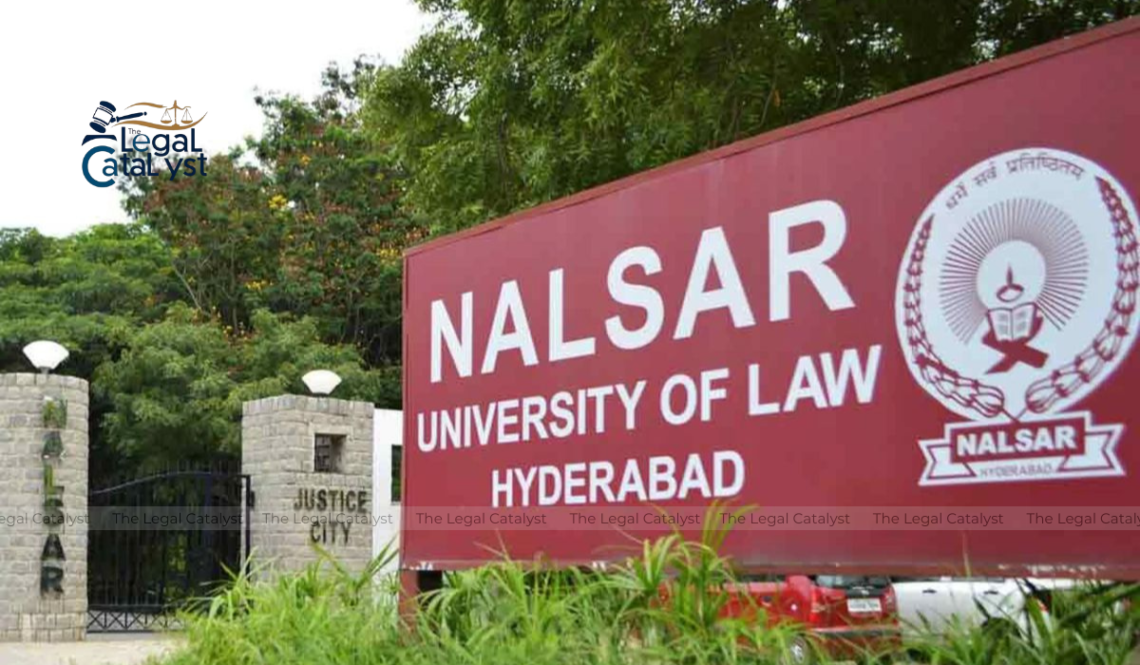
NALSAR University of Law was established in 1998 by an Act of the Andhra Pradesh Legislature. It is a public law university, currently located in Shamirpet, Hyderabad, Telangana. The university operates as an autonomous institution and is recognized by the University Grants Commission (UGC) and approved by the Bar Council of India (BCI). Its official website is www.nalsar.ac.in.
NALSAR offers a five-year integrated B.A., LL.B. (Hons.), postgraduate law programmes, doctoral research, and select executive and distance education courses. It is among the second-generation National Law Universities and was designed to replicate and refine the NLSIU model.
Foundational Objective and Institutional Intent
NALSAR was created to extend the national law university experiment beyond Bengaluru and to offer an academically rigorous, research-oriented legal education with strong professional orientation. The founding vision emphasized intellectual depth, public law scholarship, and institutional autonomy.
In its early years, NALSAR largely adhered to this intent, particularly in constitutional law, public policy, and academic research. Over time, the institution has shifted toward a more balanced but diluted model, attempting to serve corporate law, litigation, academia, and policy simultaneously. While the foundational objective of academic excellence remains formally intact, institutional focus today is less sharply defined, leading to uneven outcomes depending on student initiative and cohort dynamics.
Location-Based Academic and Career Exposure
Hyderabad offers moderate strategic advantages for legal education. It is a growing commercial and technology hub with increasing corporate legal activity, arbitration practices, and regulatory work. Students have access to internships with regional law firms, companies, tribunals, and High Court practitioners.
However, compared to Delhi or Mumbai, Hyderabad provides limited exposure to national-level litigation, top-tier policy institutions, and elite law firm ecosystems. The campus itself is located in Shamirpet, which is geographically isolated from the city’s legal and commercial centres. This isolation restricts semester-time internships and professional networking, making vacation internships more critical for career development.
Also Read- Can an FIR Be Cancelled?
Academic Structure and Teaching Methodology
The flagship programme is the B.A., LL.B. (Hons.), with a curriculum that integrates humanities and social sciences with core law subjects. Teaching is classroom-based, relying on readings, discussions, presentations, and written submissions.
Faculty composition includes senior academics with strong public law backgrounds, mid-career scholars, and visiting faculty. Academic seriousness is present, particularly in theoretical and doctrinal subjects. However, teaching quality is uneven across courses. Some classes are intellectually demanding and discussion-driven, while others are lecture-heavy with limited pedagogical innovation. The system implicitly expects students to compensate for gaps through self-study.
Academic Rigor and Evaluation Standards
Attendance requirements are formally prescribed and generally enforced, though enforcement varies by course. Evaluation methods include mid-semester exams, end-term exams, research papers, projects, and presentations.
Grading is competitive but inconsistent. While academic rigor exists, assessment standards are not uniformly transparent. Relative grading in a high-performing peer group means average students often cluster in the middle without clear differentiation. Academic pressure is real, but institutional feedback mechanisms for academic improvement are limited.
Fee Structure and Real Cost of Legal Education
Official tuition fees are approximately ₹2.4–2.8 lakh per year, subject to periodic revision. Hostel and mess charges typically add ₹1–1.2 lakh annually. Personal expenses, books, travel, and incidental costs can reasonably amount to ₹80,000–1.2 lakh per year.
The total estimated cost of completing the five-year programme is in the range of ₹22–27 lakh. This does not include opportunity costs. While lower than many private universities, the cost is significant for a public institution and must be evaluated against median career outcomes rather than peak placements.
Internship Ecosystem and Practical Exposure
Internship access at NALSAR is largely student-driven. Alumni networks assist motivated students in securing internships, particularly in corporate law, policy research, and litigation chambers. Vacation internships are the primary mode of practical exposure due to the campus’s distance from urban centres.
There is no institutional guarantee of quality internships. Students with clarity and persistence accumulate strong profiles, while others graduate with fragmented or low-impact experiences. Practical training exists in form but lacks systematic institutional integration.
Moot Court, Research, and Co-Curricular Culture
NALSAR has a historically strong moot court culture and has performed well in national and international competitions. ADR activities and research centres exist, particularly in public law, IP, and policy-oriented fields.
However, participation is highly concentrated among a subset of students. Research centres vary widely in productivity and student engagement. Publication opportunities exist, but mentorship is inconsistent. Co-curricular excellence is possible but not uniformly accessible to the average student.
Placements and Career Outcomes
The university operates a centralized placement coordination system with a primary focus on corporate law firms. Recruitment by top-tier firms occurs, but intake is limited.
For the majority of students, outcomes include mid-tier law firms, litigation apprenticeships, policy roles, higher studies, or non-legal careers. Publicly verifiable, granular placement data for median outcomes is limited, making precise assessment difficult. Career outcomes depend heavily on individual effort, networking, and early specialization.
Alumni Network and Long-Term Value
NALSAR’s alumni network is strong, particularly in academia, litigation, policy institutions, and certain corporate law segments. Alumni engagement exists through mentorship, internships, and informal guidance.
That said, alumni access is not institutionalized. Students who actively reach out benefit disproportionately. The long-term brand value of NALSAR remains solid but is not a substitute for sustained personal effort.
Campus Culture, Competition, and Student Well-Being
The campus environment is academically competitive but less overtly aggressive than some peer institutions. Peer quality is generally high, fostering intellectual engagement.
At the same time, academic pressure, uncertainty about careers, and isolation due to campus location affect student well-being. Mental health support systems exist but are limited in scope and reach. Institutional culture prioritizes autonomy over structured support, which disadvantages students needing guidance.
Administration and Institutional Governance
Administrative functioning is bureaucratic and slow. Communication gaps, delayed decisions, and inconsistent policy implementation are recurring concerns. While governance structures are formally robust, execution often lacks responsiveness and transparency.
Faculty-student engagement in institutional decision-making is limited. Administrative inefficiency remains one of the institution’s persistent structural weaknesses.
Suitability Analysis
NALSAR is best suited for students interested in academic law, public law, policy, or litigation, who are comfortable with self-directed learning and delayed career certainty. It also suits corporate law aspirants willing to independently build profiles without institutional hand-holding.
Who Should Avoid This Law School
Students seeking predictable placement outcomes, structured mentorship, or strong semester-time professional exposure may struggle. Those uncomfortable with institutional ambiguity or administrative delays should be cautious.
Comparative Positioning
Compared to National Law School of India University, NALSAR offers a calmer campus environment but weaker corporate placement consistency. In comparison with National Law University Delhi, NALSAR provides stronger academic depth in public law but significantly less exposure to elite litigation and policy institutions.
Final Verdict
NALSAR remains a credible, academically serious law school with long-term brand value. However, it does not guarantee strong outcomes for the average student. The institution offers opportunity without assurance. For students prepared to take ownership of their education and career trajectory, it can be rewarding. For others, the cost and uncertainty may outweigh the benefits.
Also Read- National Law School of India University (NLSIU), Bengaluru
The Legal Catalyst Review
Overall Institutional Standing
NALSAR occupies a stable but non-dominant position in India’s legal education ecosystem. It is respected for academic credibility rather than for producing consistently strong professional outcomes across the student body.
Core Strengths
The institution benefits from a strong academic foundation in public law, a credible alumni presence across diverse legal fields, and an intellectually capable peer group. These factors create a solid base for self-driven students.
Structural Weaknesses
Geographic isolation, administrative inefficiency, and uneven teaching quality materially affect the student experience. Institutional support systems do not adequately compensate for these structural constraints.
Return on Investment (ROI) Assessment
ROI is highly variable. Top and strategically focused students can justify the investment. For the median student, financial and time costs may not proportionately translate into career outcomes.
Consistency of Outcomes
Success at NALSAR is predominantly student-dependent. The institution facilitates opportunity but does not reliably deliver outcomes.
Final Legal Catalyst Take
NALSAR does not fail its students, but it does not carry them either. It rewards clarity, persistence, and self-management. For those expecting institutional momentum to compensate for average effort, the mismatch can be significant.
Connect with us on Instagram – X – LinkedIn for daily updates, quizzes, and other materials