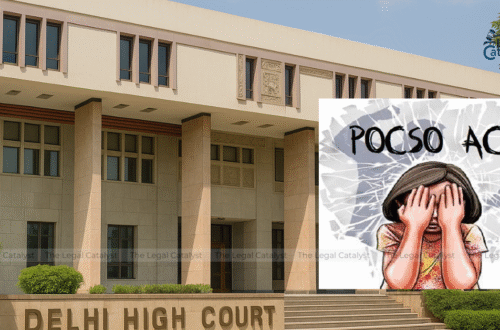

The Delhi High Court has clarified an important principle of criminal procedure: a bail application cannot be rejected solely because it is lengthy or voluminous. The Court held that when personal liberty is at stake, courts are duty-bound to decide bail pleas on merits, not on procedural convenience or docket pressure.
The ruling came while examining an order passed by a trial court which had refused to consider a bail application only because it ran into several hundred pages along with annexures.
Background of the Case
The case arose from a bail application filed by an accused in a prosecution under the Protection of Children from Sexual Offences Act (POCSO). The trial court dismissed the bail application on the ground that the petition was excessively bulky and voluminous, observing that it would be difficult to go through such a large set of documents given time constraints.
Instead of examining the substance of the bail grounds, the trial court permitted the accused to file a fresh and shorter bail application.
Aggrieved by this approach, the accused challenged the order before the Delhi High Court.
Issues Before the Delhi High Court
The High Court was essentially called upon to decide:
- Whether a bail application can be dismissed without examining merits solely due to its length
- Whether judicial workload or docket pressure can justify denial of consideration of a bail plea
- Whether such dismissal violates the constitutional right to personal liberty
Findings of the Court
The Delhi High Court categorically held that volume cannot be a ground to deny bail consideration.
The Court observed that bail applications deal directly with an individual’s liberty. Such applications cannot be rejected on superficial or administrative grounds without application of judicial mind to the merits of the case.
The Court emphasised that substance must prevail over form. Even if a bail petition is lengthy or supported by extensive annexures, the court is still required to consider whether the accused satisfies the legal parameters for grant or refusal of bail.
Right to Personal Liberty Cannot Be Compromised
The Court reiterated that personal liberty is a fundamental constitutional value. Any judicial order affecting liberty must be reasoned, merit-based, and legally sustainable.
The Delhi High Court made it clear that procedural inconvenience or time constraints cannot override constitutional obligations, especially when the consequence is continued incarceration of an undertrial.
Rejecting a bail application without examining its merits, merely because it is long, amounts to an abdication of judicial responsibility.
Case Management Is Permissible, Rejection Is Not
While the Court acknowledged that excessively long pleadings may pose practical difficulties, it drew a crucial distinction:
- Courts may regulate proceedings by directing counsel to rely on a brief synopsis or confine oral arguments
- Courts may identify relevant portions of annexures for focused consideration
However, outright dismissal of a bail application on the ground of bulk is impermissible in law.
Judicial case management tools exist precisely to handle such situations without compromising substantive justice.
Trial Court Order Set Aside
The Delhi High Court set aside the trial court’s order and directed that the bail application be considered afresh on merits in accordance with law.
It noted that the trial court failed to examine:
- The nature of allegations
- The role attributed to the accused
- Custodial period
- Evidentiary material
- Applicable bail jurisprudence
Such failure rendered the order legally unsustainable.
Legal Significance of the Ruling
This judgment carries wider implications for criminal courts across the country.
It reinforces that:
- Bail adjudication must be merit-centric, not convenience-centric
- Judicial workload cannot justify dilution of constitutional safeguards
- Procedural shortcuts in bail matters are legally impermissible
The ruling also sends a clear signal that courts must not discourage detailed legal submissions by penalising their length, particularly in complex criminal cases.
The Delhi High Court has reaffirmed a foundational principle of criminal justice: liberty cannot be curtailed through procedural avoidance. Bail applications, regardless of their length, must be examined on their legal merits.
This decision strengthens due process protections and ensures that administrative concerns do not eclipse constitutional rights.
Connect with us on Instagram – X – LinkedIn for daily updates, quizzes, and other materials