Introduction and Institutional Identity
Symbiosis Law School (SLS) is a private law school operating under Symbiosis International (Deemed University), a deemed-to-be university established in 2002 under Section 3 of the UGC Act. Legal education at Symbiosis began earlier, with Symbiosis Law School, Pune, established in 1977, later becoming part of the Symbiosis International University framework.
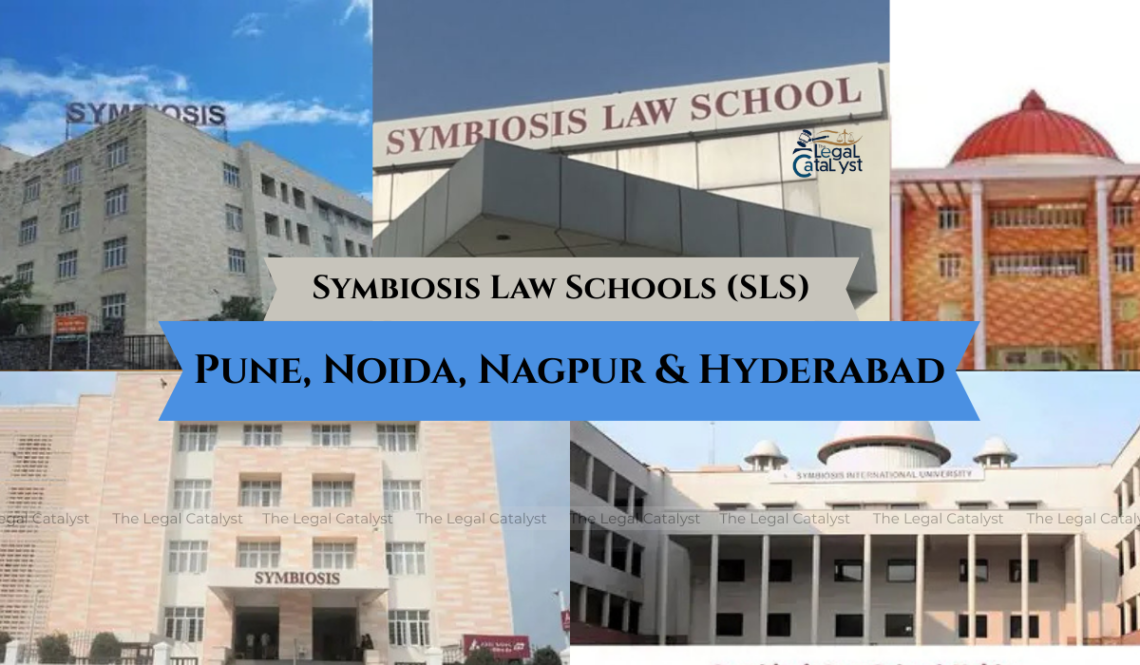
Symbiosis Law School operates through multiple campuses across India, with major law campuses located in Pune, Noida, Hyderabad, and Nagpur. All SLS campuses are recognised by the University Grants Commission and approved by the Bar Council of India. The official website for the law schools is symlaw.edu.in, with campus-specific subdomains.
SLS is a Non-NLU law institution. It follows a private university model with comparatively high fees, structured academic systems, and formal placement processes. It must therefore be evaluated against NLUs on academic rigor, exposure, and outcomes, not reputation or marketing visibility.
Foundational Objective and Institutional Evolution
The Symbiosis educational movement was founded with the objective of providing internationally oriented, professionally relevant education through private institutional initiative. Legal education at Symbiosis was initially conceived to bridge perceived gaps in traditional public universities by offering structured teaching, industry exposure, and consistent evaluation.
Over time, Symbiosis Law School expanded from a single-campus institution in Pune to a multi-campus system offering undergraduate, postgraduate, and doctoral programmes. The curriculum has evolved to include corporate law, international law, ADR, and interdisciplinary electives, aligning more closely with contemporary legal practice than many public universities. However, this evolution has also introduced internal variation in quality across campuses.
Location-Based Academic and Career Exposure
Location plays a decisive role in the practical exposure available to Symbiosis Law School students, and outcomes vary sharply by campus.
Pune
Pune offers access to trial courts, the Bombay High Court (Nagpur and Mumbai benches via travel), arbitration practices, and a moderate corporate ecosystem. Proximity to Mumbai significantly enhances exposure to law firms, chambers, and corporate internships.
Noida
The Noida campus benefits from proximity to Delhi. Students can access the Supreme Court, Delhi High Court, tribunals, law firms, think tanks, and policy institutions. Semester-time internships are realistically possible for motivated students.
Hyderabad
Hyderabad provides exposure to the Telangana High Court, state tribunals, and regional corporate offices. However, access to top-tier national law firms is limited compared to Delhi or Mumbai.
Nagpur
Nagpur offers access to the Nagpur Bench of the Bombay High Court and district courts. Corporate exposure is minimal, and opportunities are primarily litigation-focused.
Explore- Faculty of Law, University of Lucknow (LU), Lucknow, Uttar Pradesh
Courses Offered and Entry Pathways
| Programme | Duration | Entry Pathway |
|---|---|---|
| B.A. LL.B. (Hons.) | 5 years | SLAT |
| B.B.A. LL.B. (Hons.) | 5 years | SLAT |
| LL.B. | 3 years | SLAT |
| LL.M. | 1 year | AIAT |
| Ph.D. (Law) | Variable | University-level admission process |
Admissions are conducted through Symbiosis-administered entrance tests. While entry standards are competitive, student quality varies across campuses and batches.
Academic Structure and Teaching Reality
Symbiosis Law School follows a trimester-based or semester-based system depending on campus and programme. Teaching combines lectures, case discussions, presentations, and project work. Faculty composition includes permanent professors, visiting faculty from practice, and contractual lecturers.
Academic seriousness varies by campus. Pune and Noida generally demonstrate higher classroom engagement and faculty depth. Hyderabad and Nagpur show greater variability. Class sizes are smaller than public universities but larger than top NLUs.
Students are expected to manage continuous assessments, presentations, and internships alongside coursework. However, the effectiveness of this structure depends heavily on faculty enforcement and student discipline.
Academic Rigor and Evaluation Standards
Attendance requirements are formally strict, often set at 75 percent or higher, with active enforcement. Internal assessments carry significant weight and include research papers, presentations, mid-term tests, and group projects.
Examinations are moderately strict. Grading tends to be more liberal than in traditional public universities but less inflated than in some private institutions. Consistent performance is required to maintain academic standing, though grading standards vary across campuses and courses.
Fee Structure and True Cost of Education
| Cost Component | Approximate Amount (INR) |
|---|---|
| Annual Tuition Fees | 4–6 lakhs |
| Hostel and Living (Annual) | 1.5–2.5 lakhs |
| Estimated Total Course Cost (5 years) | 28–40 lakhs |
| Estimated Total Course Cost (3 years) | 15–20 lakhs |
SLS is a high-cost legal education option. While infrastructure and institutional systems justify part of the cost, the return on investment varies significantly depending on campus and individual outcomes.
Internship Ecosystem and Practical Exposure
Internships are actively encouraged and often structured through academic calendars. Students typically complete multiple internships each year. Access to quality internships is strongest at Pune and Noida.
Litigation internships are readily available across campuses. Corporate and policy internships depend heavily on location, networking, and individual initiative. The institution facilitates opportunities but does not guarantee outcomes.
Moot Court, Research, and Co-Curricular Opportunities
Mooting is a visible part of SLS culture, particularly at Pune and Noida. Students regularly participate in national and international competitions. ADR exposure is stronger than in most public universities, with formal courses and competitions.
Research centres and journals exist across campuses, though output quality varies. Undergraduate research opportunities are available but require proactive engagement.
Explore- Faculty of Law, University of Delhi (DU)
Placements and Career Outcomes
SLS maintains formal placement cells, particularly at Pune and Noida. Placement processes are structured, but transparency in consolidated placement data is limited.
Average outcomes include placements in mid-tier law firms, boutique practices, in-house legal teams, compliance roles, and litigation chambers. Top-tier firm placements exist but represent a minority of the batch. Outcomes at Hyderabad and Nagpur are more litigation- and regional-practice-oriented.
Alumni Network and Long-Term Value
Symbiosis has a growing alumni network across litigation, law firms, corporate legal teams, and academia. Alumni presence is strongest in Pune, Mumbai, and Delhi. Long-term value depends on sustained networking and individual career progression rather than institutional intervention alone.
Campus Culture and Student Experience
Campus life is structured and competitive. Peer quality varies by campus, with higher academic intensity at Pune and Noida. Discipline is actively enforced through attendance rules and academic monitoring.
Student support systems such as counselling, career services, and student committees are formally established, though effectiveness varies.
Administration and Institutional Governance
Administrative systems are more responsive than those in public universities but remain hierarchical. Academic calendars are generally predictable. Grievance mechanisms exist but may be slow in practice. Decision-making is centralised under the university administration.
Multi-Campus or Branch Structure
Symbiosis Law School operates across multiple campuses.
| Campus | Location | Relative Exposure | Placement Strength |
|---|---|---|---|
| SLS Pune | Pune, Maharashtra | High | Strong |
| SLS Noida | Noida, Uttar Pradesh | High | Strong |
| SLS Hyderabad | Hyderabad, Telangana | Moderate | Moderate |
| SLS Nagpur | Nagpur, Maharashtra | Low | Limited |
Admissions, degrees, and curriculum are centralised under Symbiosis International University, but faculty strength, exposure, and outcomes are campus-specific. Uniform quality should not be assumed.
Suitability Analysis
Symbiosis Law School is best suited for students who can afford high fees, prefer structured academic environments, and are willing to pursue internships and skills development actively. Students targeting corporate law, compliance, ADR, or policy work benefit most from Pune and Noida campuses.
Who Should Avoid This University
Cost-sensitive students, those seeking guaranteed top-tier placements, or those preferring low-pressure academic environments may find SLS unsuitable. Students enrolling in lower-exposure campuses with expectations similar to NLUs may face disappointment.
Comparative Positioning
Compared to Jindal Global Law School, Symbiosis Law School is more practice-oriented and less research-driven. Compared to Government Law College Mumbai, it offers better institutional support but at significantly higher cost. It competes with mid-tier NLUs in structure but not consistently in outcomes.
Explore- Faculty of Law, Banaras Hindu University (BHU), Varanasi, Uttar Pradesh
Final Verdict
Symbiosis Law School is a structured, high-cost private law education system with meaningful advantages in exposure and organisation, particularly at its Pune and Noida campuses. It does not uniformly match top NLUs in academic rigor or placements, and outcomes vary sharply by campus and student initiative. For financially capable, disciplined students who choose the right campus and actively build their profiles, SLS can offer reasonable return on investment. For others, especially those entering with NLU-level expectations across all campuses, the value proposition is uncertain.
Connect with us on Instagram – X – LinkedIn for daily updates, quizzes, and other materials