- Introduction and Institutional Identity
- Foundational Objective and Institutional Evolution
- Location-Based Academic and Career Exposure
- Courses Offered and Entry Pathways
- Academic Structure and Teaching Reality
- Academic Rigor and Evaluation Standards
- Fee Structure and True Cost of Education
- Internship Ecosystem and Practical Exposure
- Moot Court, Research, and Co-Curricular Opportunities
- Placements and Career Outcomes
- Alumni Network and Long-Term Value
- Campus Culture and Student Experience
- Administration and Institutional Governance
- Multi-Campus or Branch Structure
- Suitability Analysis
- Who Should Avoid This University
- Comparative Positioning
- Final Verdict
Introduction and Institutional Identity
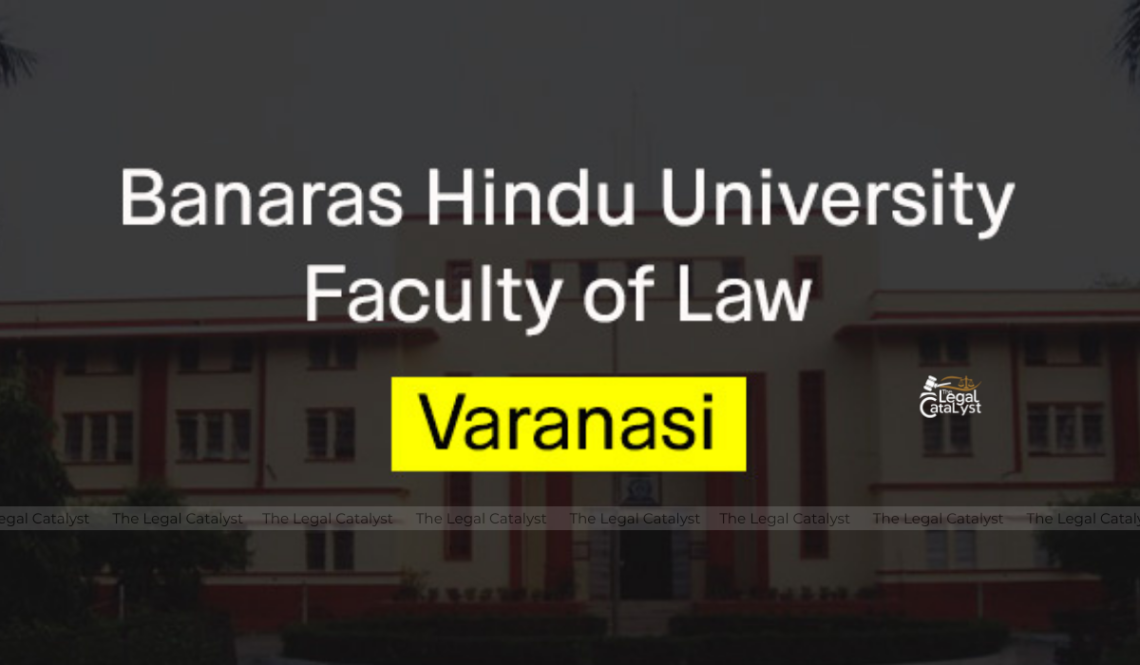
The Faculty of Law, Banaras Hindu University, is a constituent faculty of Banaras Hindu University, one of India’s oldest central universities. The law faculty was formally established in 1924, making it among the earliest institutional providers of legal education in the country. It operates as a public, non-autonomous law faculty within a central university framework rather than as an independent law school.
The institution is located within the main BHU campus in Varanasi, Uttar Pradesh. It is recognised by the University Grants Commission and the Bar Council of India, enabling its graduates to enrol as advocates in India.
As a Non-NLU law institution, the Faculty of Law, BHU, follows a conventional public university model with large student intake, low fees, and limited institutional hand-holding. It must be evaluated on outcomes, academic seriousness, and exposure rather than brand perception.
Foundational Objective and Institutional Evolution
The Faculty of Law was established during the early twentieth century with the objective of creating trained legal professionals for courts, administration, and public life in colonial and later independent India. Its initial focus was on doctrinal legal education rooted in statute, case law, and procedural understanding, primarily to support litigation and civil services.
Over time, the faculty expanded in size and scope, introducing postgraduate and doctoral programmes and, more recently, a five-year integrated LL.B. programme. Unlike National Law Universities, which were created as reform-oriented institutions with integrated curricula, continuous evaluation, and residential learning, BHU’s law programmes evolved incrementally within a traditional university structure. The result is a curriculum that is formally comprehensive but institutionally conservative in pedagogy and assessment.
Explore- Dr. Rajendra Prasad National Law University (RPNLU), Prayagraj
Location-Based Academic and Career Exposure
Varanasi is a historically significant city but a limited legal market when compared to metros.
Advantages
The presence of the Allahabad High Court’s jurisdiction over the region and district courts in and around Varanasi provides access to litigation exposure, particularly at the trial court level. Students interested in grassroots litigation, criminal practice, or judicial services preparation benefit from proximity to active lower courts.
Limitations
There is no High Court bench in Varanasi, and exposure to corporate law firms, regulatory bodies, and policy institutions is minimal. Internships with national law firms, senior advocates, or corporate legal teams usually require students to travel to Delhi, Mumbai, or other metros during vacations. Semester-time internships are uncommon due to distance and academic scheduling.
Courses Offered and Entry Pathways
| Programme | Duration | Entry Pathway |
|---|---|---|
| B.A. LL.B. (Hons.) | 5 years | CUET-UG |
| LL.B. | 3 years | CUET-PG |
| LL.M. | 1–2 years | CUET-PG |
| Ph.D. (Law) | Variable | University-level admission process |
Admissions are centralised through CUET, reducing discretion in entry. However, student quality varies considerably across programmes, particularly in large undergraduate batches.
Academic Structure and Teaching Reality
Teaching is predominantly lecture-oriented. Class sizes are large, especially in the three-year LL.B. programme. Faculty strength includes senior professors with strong doctrinal knowledge, along with junior and contractual faculty members.
Classroom seriousness depends heavily on the instructor. Some courses are rigorous and conceptually demanding, while others are delivered at a basic level. There is limited use of case-based teaching, simulations, or continuous skills training. Students are expected to self-study extensively if they aim to develop practical competence.
Academic Rigor and Evaluation Standards
Attendance requirements exist formally, but enforcement varies. Internal assessments typically include written tests, presentations, or assignments, but their weightage and evaluation standards are inconsistent.
End-semester examinations remain the dominant evaluation tool. The grading culture is conservative, with limited grade inflation. High distinctions are uncommon. This benefits academically disciplined students but offers little formative feedback to average performers.
Fee Structure and True Cost of Education
| Cost Component | Approximate Amount (INR) |
|---|---|
| Annual Tuition Fees | 3,000–8,000 |
| Hostel and Living (Annual) | 60,000–1,20,000 |
| Estimated Total Course Cost (5 years) | 3–4.5 lakhs |
| Estimated Total Course Cost (3 years) | 2–2.5 lakhs |
The Faculty of Law, BHU, is among the most affordable law education options in India. However, low cost corresponds with limited institutional services, infrastructure constraints, and minimal career support.
Internship Ecosystem and Practical Exposure
Internships are entirely student-driven. Most students intern under local advocates or district court practitioners during semesters or short breaks. Vacation internships in metros are possible but require personal initiative and financial capacity.
Clinical legal education exists formally but is limited in intensity. Practical exposure is strongest for students interested in litigation rather than corporate or policy-oriented careers.
Moot Court, Research, and Co-Curricular Opportunities
Moot court activities exist but are not central to institutional culture. Participation depends largely on student interest rather than structured faculty mentoring. ADR exposure is limited and largely theoretical.
Research centres and journals exist, particularly for postgraduate scholars, but undergraduate research mentoring is inconsistent. Publication opportunities are available but not systematically integrated into coursework.
Placements and Career Outcomes
There is no centralised placement cell comparable to NLUs or leading private law schools. Placement data is not publicly consolidated, limiting transparency.
For the majority of students, outcomes include litigation practice, judicial services preparation, higher studies, or non-legal careers. A small number secure law firm roles or academic fellowships, but these outcomes are not representative of the average student experience.
Explore- Dharmashastra National Law University (DNLU), Jabalpur
Alumni Network and Long-Term Value
BHU has a vast alumni base across decades. Alumni are present in litigation, judiciary, academia, bureaucracy, and politics. However, alumni engagement with current students is informal and unstructured. Networking benefits accrue slowly and depend on individual outreach rather than institutional facilitation.
Campus Culture and Student Experience
The law faculty operates within the larger BHU campus, offering a residential university environment. Peer quality varies widely. Competition exists but is not uniformly academic.
Discipline is moderate. Student societies function but with limited funding and administrative support. Formal student counselling, mental health services, and career guidance are minimal.
Administration and Institutional Governance
Administrative processes reflect a typical large public university system. Delays in examinations, results, and documentation are common. Communication gaps between administration and students affect planning for internships and further studies. Grievance redressal mechanisms exist but are slow.
Multi-Campus or Branch Structure
Banaras Hindu University operates primarily from its Varanasi campus. The Faculty of Law is housed within this single campus. There are no separate branch campuses offering law programmes. Admissions, academics, and administration are centralised within the main university.
Suitability Analysis
The Faculty of Law, BHU, is best suited for students who are cost-sensitive, inclined toward litigation or judicial services, and comfortable with self-directed learning. Students who value a residential campus environment and are willing to compensate for institutional gaps through personal effort benefit most.
Who Should Avoid This University
Students seeking structured corporate placements, intensive faculty mentoring, small batch sizes, or modern pedagogical methods may find the institution limiting. Those unwilling to navigate administrative delays or build external networks independently are likely to struggle.
Comparative Positioning
Compared to Faculty of Law, University of Delhi, BHU offers lower cost and a residential environment but weaker metropolitan exposure. Compared to Government Law College Mumbai, it provides stronger campus life but significantly less industry access. It does not match NLUs in placements or institutional support but competes on affordability and litigation-oriented foundations.
Explore- Faculty of Law, University of Delhi (DU)
Final Verdict
The Faculty of Law, Banaras Hindu University, is a low-cost, legacy institution offering foundational legal education within a traditional university framework. It does not provide structured career pathways or modern legal training systems. For disciplined, self-driven students focused on litigation or public service, it can offer long-term value. For students expecting institutional guarantees or corporate career facilitation, it is unlikely to justify the time and effort. The return on investment depends almost entirely on the student, not the institution.
Connect with us on Instagram – X – LinkedIn for daily updates, quizzes, and other materials