- Introduction and Institutional Identity
- Foundational Objective and Institutional Intent
- Location-Based Academic and Career Exposure
- Academic Structure and Teaching Methodology
- Academic Rigor and Evaluation Standards
- Fee Structure and Real Cost of Legal Education
- Internship Ecosystem and Practical Exposure
- Moot Court, Research, and Co-Curricular Culture
- Placements and Career Outcomes
- Alumni Network and Long-Term Value
- Campus Culture, Competition, and Student Well-Being
- Administration and Institutional Governance
- Suitability Analysis
- Who Should Avoid This Law School
- Comparative Positioning
- Final Verdict
- Overall Institutional Standing
- Core Strengths
- Structural Weaknesses
- Return on Investment (ROI) Assessment
- Consistency of Outcomes
- Final Legal Catalyst Take
Introduction and Institutional Identity
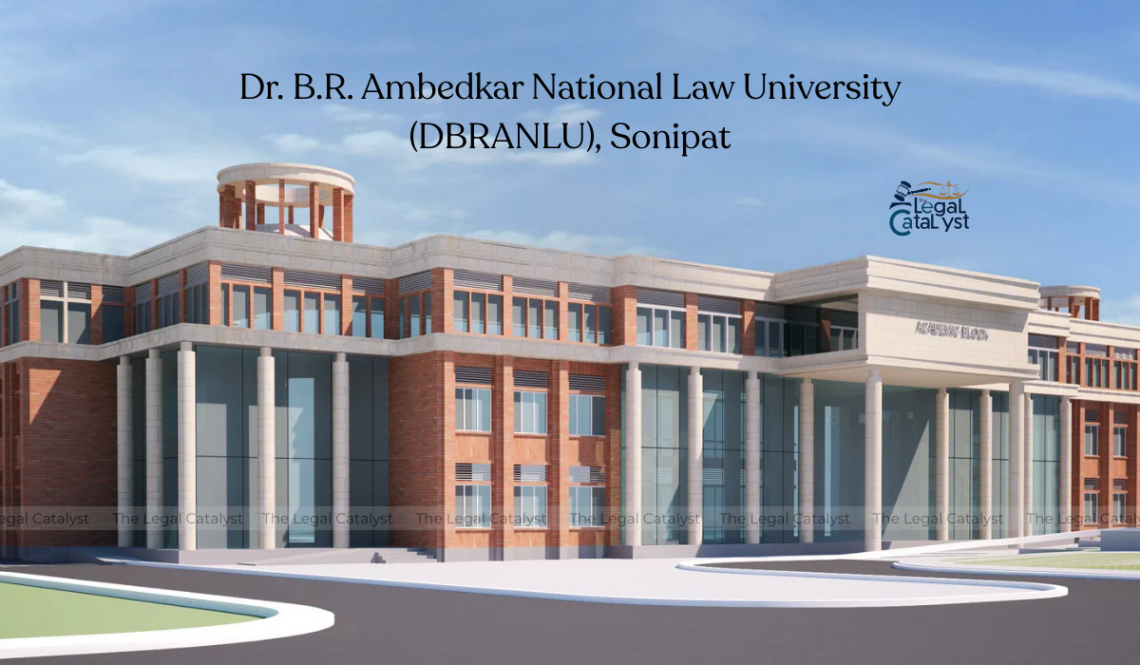
Dr. B.R. Ambedkar National Law University (DBRANLU) was established in 2016 by an Act of the Haryana State Legislature. It is a public law university, located in Sonipat, Haryana, and functions as an autonomous institution. The university is recognized by the University Grants Commission (UGC) and approved by the Bar Council of India (BCI). Its official website is www.dbranlu.ac.in.
DBRANLU offers a five-year B.A., LL.B. (Hons.), an LL.M., doctoral programmes, and limited short-term academic courses. It is among the newer National Law Universities and was expected to leverage its geographic proximity to the National Capital Region.
Foundational Objective and Institutional Intent
DBRANLU was created to expand access to national-level legal education in Haryana and to complement Delhi-based legal institutions by offering a structured NLU alternative in the NCR periphery. The stated intent combined regional access with potential national exposure due to location.
In practice, this dual intent has not been fully realised. While the university benefits from proximity to Delhi, institutional systems have not effectively converted this advantage into academic or professional outcomes. The institution has focused more on administrative continuity and infrastructure consolidation than on building a competitive academic or placement ecosystem. Alignment with founding intent is partial and under-executed.
Location-Based Academic and Career Exposure
Sonipat’s proximity to Delhi is DBRANLU’s single most significant structural advantage. In theory, students have access to the Supreme Court of India, Delhi High Court, tribunals, law firms, think tanks, and policy institutions.
In practice, this advantage is inconsistently leveraged. Semester-time internships are possible, but logistical challenges, academic scheduling, and lack of institutional facilitation limit uptake for average students. Proactive students benefit; average students often fail to convert proximity into sustained exposure. Sonipat itself offers negligible legal opportunity density.
Also Explore- Maharashtra National Law University (MNLU), Mumbai
Academic Structure and Teaching Methodology
The B.A., LL.B. (Hons.) programme follows the standard NLU curriculum with humanities subjects in early years and doctrinal law courses in later semesters. Teaching methodology is largely lecture-driven, supplemented by internal assessments and projects.
Faculty composition is uneven and unstable. Faculty shortages, turnover, and reliance on visiting or contractual faculty affect course continuity and academic depth. Teaching quality varies significantly across subjects. There is limited emphasis on rigorous classroom discussion, skills training, or research-led pedagogy. Academic seriousness exists more as expectation than as institutional culture.
Academic Rigor and Evaluation Standards
Attendance requirements are formally prescribed and enforced with moderate consistency. Evaluation methods include mid-semester examinations, end-term examinations, internal assessments, and written assignments.
Academic rigor is moderate at best. Grading standards are relatively lenient, competitive pressure is limited, and academic differentiation is weak. This reduces stress but also weakens intellectual discipline. Structured academic mentoring and feedback mechanisms are minimal.
Fee Structure and Real Cost of Legal Education
Official tuition fees are approximately ₹2.5–2.8 lakh per year. Hostel and mess charges add around ₹1–1.2 lakh annually. Living expenses in Sonipat are moderate, with personal and incidental costs typically ranging between ₹70,000–90,000 per year.
The total estimated cost of completing the five-year programme is approximately ₹22–25 lakh. This places DBRANLU in the mid-to-upper cost bracket among newer NLUs. Given average outcomes, the cost-benefit balance is a legitimate concern.
Internship Ecosystem and Practical Exposure
DBRANLU’s internship ecosystem is theoretically strong but institutionally weak. Delhi-based internships during semesters are possible but largely student-driven.
There is minimal structured guidance, limited alumni facilitation, and no institutional pipeline ensuring baseline internship quality. A small number of students build strong profiles through personal initiative. The majority graduate with fragmented or uneven practical exposure.
Moot Court, Research, and Co-Curricular Culture
The university has functioning moot court and ADR societies, but co-curricular culture is thin and inconsistent. Participation in national competitions is limited and concentrated among a small group of students.
Research centres and journals exist but produce limited output. Faculty mentorship for research and publication is sporadic. Co-curricular development depends almost entirely on student motivation rather than institutional design.
Placements and Career Outcomes
Placement outcomes at DBRANLU are weak and inconsistent. Recruitment by top-tier or even mid-tier national law firms is rare.
Most graduates pursue litigation, judicial services preparation, compliance roles, higher studies, or non-legal careers. Publicly verifiable, granular data on median placements is not consistently available, but available indicators suggest low institutional placement leverage. Outcomes are overwhelmingly student-dependent.
Also Explore- Tamil Nadu National Law University (TNNLU), Tiruchirappalli
Alumni Network and Long-Term Value
DBRANLU’s alumni network is young and underdeveloped. Alumni are present in litigation, government roles, and small firms, primarily in Delhi and Haryana.
Alumni engagement with current students is limited and informal. The network does not yet provide meaningful leverage for internships or placements. Long-term brand value remains weak and uncertain.
Campus Culture, Competition, and Student Well-Being
Campus culture is moderate-pressure but directionless. Peer competition exists in pockets, especially among students targeting Delhi-based opportunities, but overall ambition levels vary widely.
Mental health and counselling infrastructure is minimal. Institutional support systems for academic stress and career uncertainty are underdeveloped. Students are largely expected to self-manage pressure and planning.
Administration and Institutional Governance
Administrative functioning is bureaucratic and uneven. Communication delays, policy ambiguity, and procedural rigidity are recurring concerns. Leadership transitions have periodically disrupted institutional momentum.
While governance structures formally exist, execution lacks efficiency and strategic clarity. Administrative inertia continues to limit academic consolidation and professional integration.
Suitability Analysis
DBRANLU is best suited for students who are highly self-driven, intent on leveraging Delhi-based litigation, judicial services preparation, or policy exposure, and who are capable of operating with minimal institutional support.
Who Should Avoid This Law School
Students seeking institution-driven placements, strong academic mentorship, research-intensive education, or predictable career outcomes should avoid DBRANLU. Those relying on proximity to Delhi as a substitute for institutional strength are likely to be disappointed.
Comparative Positioning
Compared to National Law University Delhi, DBRANLU lacks academic depth, alumni leverage, and institutional credibility despite geographic proximity. In comparison with Hidayatullah National Law University, DBRANLU offers better location-based opportunity but similar weaknesses in faculty stability and placements.
Final Verdict
DBRANLU Sonipat is a high-potential but poorly converted law university. It offers geographic access without institutional leverage. For disciplined, strategic students, Delhi proximity can partially compensate for systemic weaknesses. For the average student, the university does not reliably justify the financial and time investment.
Also Explore- Dharmashastra National Law University (DNLU), Jabalpur
The Legal Catalyst Review
Overall Institutional Standing
DBRANLU occupies a lower-middle position within India’s national law university ecosystem. Its standing is driven more by location than by institutional performance.
Core Strengths
Proximity to Delhi, access to national courts and institutions, and a regulated NLU framework provide conditional value for proactive students.
Structural Weaknesses
Faculty instability, weak placement systems, limited research culture, underdeveloped alumni network, and administrative inconsistency significantly undermine average outcomes.
Return on Investment (ROI) Assessment
ROI is uncertain and uneven. For a small subset of students leveraging Delhi effectively, returns can be acceptable. For the median student, outcomes rarely justify the cost without exceptional effort.
Consistency of Outcomes
Success at DBRANLU is predominantly student-dependent. The institution provides access, not assurance.
Final Legal Catalyst Take
DBRANLU delivers proximity without protection. It does not offer predictable value and requires sustained, strategic self-direction to overcome institutional weaknesses. This is not a school where average effort produces average returns.
Connect with us on Instagram – X – LinkedIn for daily updates, quizzes, and other materials