- Introduction and Institutional Identity
- Foundational Objective and Institutional Intent
- Location-Based Academic and Career Exposure
- Academic Structure and Teaching Methodology
- Academic Rigor and Evaluation Standards
- Fee Structure and Real Cost of Legal Education
- Internship Ecosystem and Practical Exposure
- Moot Court, Research, and Co-Curricular Culture
- Placements and Career Outcomes
- Alumni Network and Long-Term Value
- Campus Culture, Competition, and Student Well-Being
- Administration and Institutional Governance
- Suitability Analysis
- Who Should Avoid This Law School
- Comparative Positioning
- Final Verdict
- Overall Institutional Standing
- Core Strengths
- Structural Weaknesses
- Return on Investment (ROI) Assessment
- Consistency of Outcomes
- Final Legal Catalyst Take
Introduction and Institutional Identity
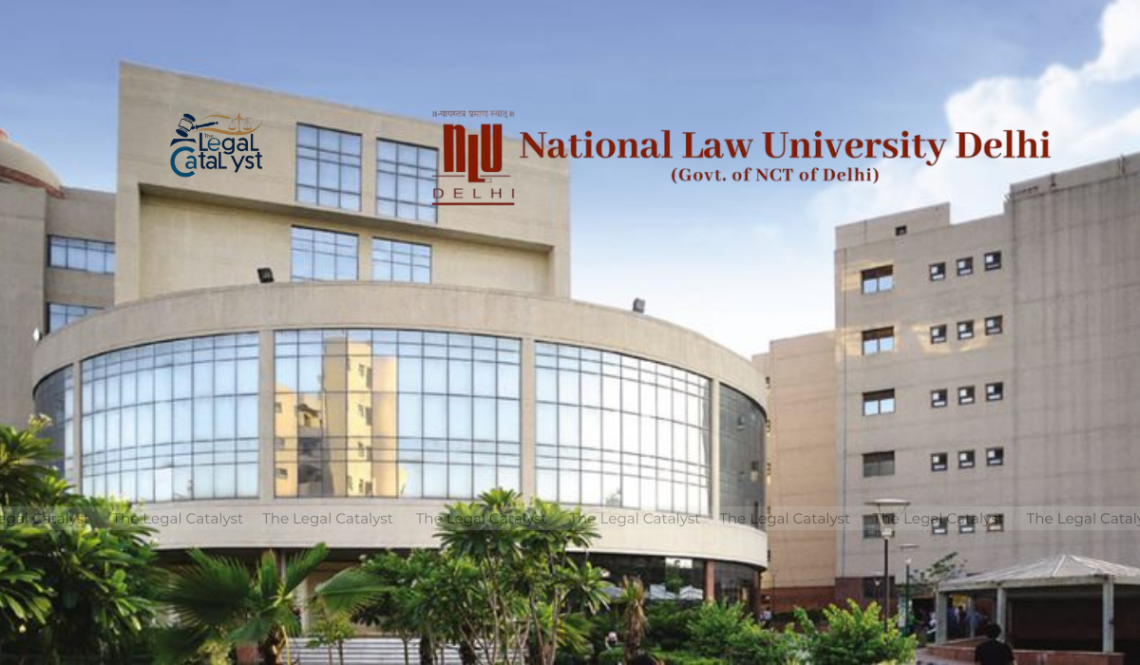
National Law University Delhi (NLU Delhi) was established in 2008 by an Act of the National Capital Territory of Delhi. It is a public law university, located in Dwarka, New Delhi. The institution functions as an autonomous university and is recognized by the University Grants Commission (UGC) and approved by the Bar Council of India (BCI). The official website of the university is www.nludelhi.ac.in.
NLU Delhi offers a five-year B.A., LL.B. (Hons.), an LL.M., doctoral programmes, and a limited set of diploma and executive courses. Unlike most NLUs, it conducts its own entrance examination, the All India Law Entrance Test (AILET), rather than participating in CLAT.
Foundational Objective and Institutional Intent
NLU Delhi was created with a specific institutional intent: to establish a nationally competitive law university in the capital that could leverage proximity to the Supreme Court, central government institutions, regulatory bodies, and policy think tanks. The founding vision was to combine rigorous legal education with direct exposure to the functioning of India’s highest legal and constitutional institutions.
In practice, the institution has partially fulfilled this intent. Its location-driven advantages have materialised strongly, especially in litigation, policy, and public law exposure. However, the broader academic and institutional framework has struggled with consistency. While the objective of elite legal training remains intact, the delivery is uneven, and the institution relies heavily on student self-navigation to convert proximity into outcomes.
Location-Based Academic and Career Exposure
Delhi is structurally unmatched in terms of legal exposure. Students have access to the Supreme Court of India, Delhi High Court, national tribunals, ministries, regulators, commissions, law firms, policy organisations, and international bodies. Semester-time internships are realistically possible, particularly in litigation, research, and policy roles.
This advantage, however, comes with trade-offs. Competition for meaningful internships in Delhi is intense, and institutional mediation is limited. Students without clarity or networks can easily be sidelined. Additionally, the cost of living in Delhi is high, and the distractions of the city can dilute academic focus. The city provides opportunity density, not outcome certainty.
Also Read- National Law School of India University (NLSIU), Bengaluru
Academic Structure and Teaching Methodology
The B.A., LL.B. (Hons.) programme follows an interdisciplinary structure, combining humanities subjects with core legal courses. Teaching is largely classroom-based, with a mix of lectures, discussions, presentations, and written assessments.
Faculty composition is uneven. The university has several respected scholars and practitioners, particularly in public law, criminal law, and constitutional studies. At the same time, faculty turnover, contractual appointments, and gaps in teaching depth across subjects affect academic continuity. Some courses are rigorous and intellectually demanding; others depend heavily on student self-study with limited pedagogical engagement.
Academic seriousness exists, but it is not uniformly institutionalised.
Academic Rigor and Evaluation Standards
Attendance requirements are formally prescribed and generally enforced, though enforcement varies by faculty member. Evaluation methods include mid-term exams, end-term exams, research papers, projects, and class participation.
Grading is competitive and can be unforgiving. Relative grading in a small, high-performing batch increases pressure. However, evaluation standards are not always transparent or consistent across courses. Feedback mechanisms for academic improvement are limited, placing the burden of performance optimisation on students.
Fee Structure and Real Cost of Legal Education
Official tuition fees are approximately ₹1.8–2.0 lakh per year. Hostel and mess charges typically add ₹1.2–1.4 lakh annually. Living expenses, books, travel, and incidental costs in Delhi can reasonably amount to ₹1.2–1.5 lakh per year, even for students residing on campus.
The total estimated cost of completing the five-year programme falls in the range of ₹22–26 lakh. While the tuition component is lower than many peers, overall costs are elevated due to the city. This investment must be assessed against median career outcomes rather than elite placements.
Internship Ecosystem and Practical Exposure
NLU Delhi’s location enables strong access to internships during both semesters and vacations. Students regularly intern with advocates-on-record, senior advocates, law firms, think tanks, NGOs, and government bodies.
However, the system is entirely student-driven. There is no structured institutional pipeline for internships. Alumni support exists but is informal and unevenly accessed. Practical exposure varies drastically across students, depending on initiative, networking ability, and clarity of career direction.
Moot Court, Research, and Co-Curricular Culture
The university has an active moot court culture and has participated in several national and international competitions. ADR activities, research centres, and journals exist, particularly in criminal justice, constitutional law, and policy-oriented fields.
That said, participation and success are concentrated among a small segment of students. Research centres vary significantly in output and student integration. Publication opportunities are available, but sustained faculty mentorship is inconsistent. Co-curricular systems reward self-selected excellence rather than systematically developing average students.
Placements and Career Outcomes
NLU Delhi has a centralized placement coordination committee, primarily oriented toward corporate law firm recruitment. Top-tier firms recruit in limited numbers.
For the majority of students, outcomes include litigation, policy research, higher studies, judicial services preparation, mid-tier firms, or non-legal careers. Granular, publicly verifiable data on median placements is limited, making precise outcome analysis difficult. What is clear is that institutional brand alone does not guarantee placement security.
Alumni Network and Long-Term Value
The alumni base is younger compared to first-generation NLUs but is increasingly visible in litigation, academia, policy, and firms. Alumni engagement exists through mentorship and internships, particularly in Delhi-based roles.
However, alumni support is not structurally embedded into the academic or career framework. Students who actively seek engagement benefit more than those who rely on institutional facilitation. Long-term brand value is growing but still maturing.
Also Read- Can an FIR Be Cancelled?
Campus Culture, Competition, and Student Well-Being
Peer quality is high, and competition is intense. The environment is intellectually stimulating but also high-pressure. Comparison, performance anxiety, and career uncertainty are common.
Mental health support systems exist but are limited in scale and effectiveness. The institutional culture prioritizes independence and resilience over structured pastoral support. Students who struggle academically or emotionally may find limited institutional cushioning.
Administration and Institutional Governance
Administrative functioning is inconsistent. While some academic processes are efficiently managed, others suffer from delays, communication gaps, and policy ambiguity. Faculty recruitment and retention have been recurring challenges.
Decision-making is often centralized, with limited transparency. Governance structures exist, but execution does not consistently match the expectations associated with a national institution located in the capital.
Suitability Analysis
NLU Delhi is best suited for students targeting litigation, policy, constitutional law, criminal law, and public affairs, who are capable of independently leveraging Delhi’s ecosystem. It also suits self-driven corporate law aspirants willing to navigate a competitive and unstructured placement environment.
Who Should Avoid This Law School
Students seeking predictable placement outcomes, strong institutional hand-holding, or a tightly structured academic environment may struggle. Those uncomfortable with ambiguity, administrative delays, or intense peer competition should approach cautiously.
Comparative Positioning
Compared to National Law School of India University, NLU Delhi offers superior litigation and policy exposure but weaker alumni depth and academic continuity. In comparison with NALSAR University of Law, NLU Delhi provides stronger location-based opportunities but less academic insulation and campus stability.
Final Verdict
NLU Delhi is a high-opportunity, high-variance institution. It offers access to India’s most powerful legal ecosystem but does not systemically convert that access into outcomes for the average student. The university rewards strategic clarity, resilience, and initiative. Without these, the return on investment can be uncertain despite the institution’s location and reputation.
Also Read– NALSAR University of Law, Hyderabad
The Legal Catalyst Review
Overall Institutional Standing
NLU Delhi occupies a strategic but unstable position within India’s legal education ecosystem. Its relevance is driven more by geography than by institutional consistency.
Core Strengths
Its proximity to the Supreme Court and central institutions materially benefits students interested in litigation and policy. The peer group is academically capable, and opportunity density is high for those who know how to navigate it.
Structural Weaknesses
Academic inconsistency, administrative inefficiency, and limited institutional career scaffolding are persistent limitations. Outcomes vary sharply across the student body.
Return on Investment (ROI) Assessment
ROI is uneven. For students who fully exploit Delhi’s ecosystem, returns can justify the cost. For the median student, financial and time investments do not reliably translate into proportional career outcomes.
Consistency of Outcomes
Success at NLU Delhi is predominantly student-dependent. The institution provides access, not assurance.
Final Legal Catalyst Take
NLU Delhi delivers proximity, not predictability. It can be powerful in the hands of focused, self-directed students. For those expecting the institution itself to drive outcomes, the gap between expectation and reality can be significant.
Connect with us on Instagram – X – LinkedIn for daily updates, quizzes, and other materials